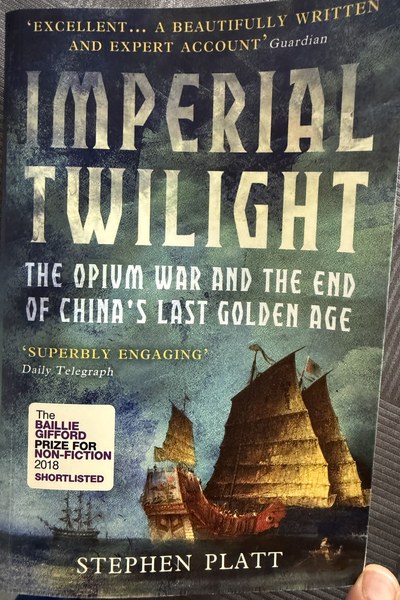
Imperial Twilight by Stephen Platt
Stephen Platt's Imperial Twilight tells the story of the Opium Wars with more sympathy for the Chinese side than most Western histories—but it is still a Western book. The narrative arc is familiar: a declining Qing dynasty, a rising British Empire, a collision that neither side fully intended but both enabled. Platt gives Chinese actors more agency than most, but he frames their agency as reaction: the emperor responds to British gifts, the bureaucrat responds to opium smuggling, the court responds to rebellion. The British, by contrast, are presented as actors: they debate, they deliberate, they decide. The asymmetry is subtle but persistent.
What Platt does well is show the contingency of the conflict. This was not a war waiting to happen. As Platt argues, the breakdown of Sino-British relations was a "sudden departure from decades, if not centuries, of generally peaceful and respectful precedent". It was a series of choices—some principled, some corrupt, some desperate—that compounded into catastrophe. And what he shows, perhaps without intending to, is that the people who understood the situation best were not the emperors or the parliamentarians. They were the middlemen.
The Beginning of the End of the Qing Dynasty
The book opens by building the aura of the Chinese emperor—his rituals, his seclusion, his carefully managed mystique. This is a ruler who wants the best for his people, who is curious about Western technology (he secretly asks monks to reverse-engineer British gifts while publicly feigning indifference), and who is visionary enough to name the prince who defended the palace as his successor. But he is also controlling. He refuses to relinquish power after abdication, forcing his successor to wait until his death to punish the corrupt officials who enriched themselves through proximity to the throne.
This is a portrait of a system that works—until it doesn't. The emperor's dual behavior toward the British is a microcosm of the Qing's broader dilemma: they knew they were falling behind, but they could not admit it, and they could not adapt fast enough to catch up.
The economic dimension is where the book becomes most relevant to our own moment. Theories emerged in China that the tax burden had increased because the copper-to-silver ratio had become unsustainable. The theory had merit: silver was being shipped out of the country to pay for opium, and the outflow was tracked from Chinese markets to foreign merchants. The locals bought opium—a contraband—in silver. The smugglers paid the foreign merchants in silver. The merchants could not trade silver in Chinese markets, so they sent it to Britain, where it was melted into bullion. The scarcity of silver was compounded by restricted mining supply from Mexico and Latin America, but this was unknown at the time.
So the Chinese did what people do when they are frightened and uncertain: they implemented stricter laws without considerable thought. The bureaucrat demanded that opium sellers disclose and submit their opium at fair market value. He gave them a day. The foreign merchants, meanwhile, were discussing strategy with the British Parliament, while their representative in the East made desperate compromises to avoid violence.
The result was predictable. When you demand surrender without offering a face-saving exit, you get war.
What Was at Stake, and Who Was in the Middle?
Individually, none of the friction between China and Britain was enough to justify war. It was the cumulative effect that made the tension unbearable. Breaking with traditional diplomacy. Using missionaries to smuggle opium and map the coastline. Negotiating directly with the emperor, bypassing the tribute system. Violating rules about foreign women in the factory town during winters. These transgressions gave China's anger a basis—but the Western powers couldn't see it from their own moral high ground. They mistook Chinese curiosity about their culture for ignorance and backwardness. The lack of direct access to China's interior led them to underestimate the consequences of their actions.
And in the middle of it all were Howqua and John Murray Forbes.
Howqua handled the vast majority of foreign merchants' transactions in China—without formal paperwork, without legal standing, without any protection except his own reputation. He understood capitalism as it actually is: market trust. Not contracts, not treaties, not gunboats. Trust. Forbes understood it too. They were the ones who made the system work, not because they had power, but because both sides trusted them. The Qing trusted Howqua to manage the foreigners. The British and Americans trusted him to manage the Chinese. He was indispensable—and therefore extremely vulnerable.
The middleman's position is always precarious. You are trusted only as long as you are seen as neutral. The moment one side believes you have been captured by the other, you are finished. Howqua was arrested by Lin Zexu. Forbes survived and thrived. The difference was not virtue or skill—it was timing and luck. During the Opium War, Howqua entrusted some one million dollars' worth of cargo to his American partners, including Forbes, to shield his assets from the turmoil in Canton. Forbes later returned the investment profits to Howqua's heirs. That money continued to fund American railroads for fifty years after Howqua's death. That is the win. But Howqua himself didn't live to see it. He died in September 1843, a few months after the Treaty of Nanking, writing to Forbes that if he were younger, he would seriously consider sailing to America to settle.
So the lesson needs revision: the middleman who maintains trust across both sides wins, but what wins is the future - successors - they invested in, not their own present. Howqua's wealth continued growing after his death, but he himself was abandoned by both systems while alive. The middleman's victory is intergenerational, not personal. That is crueler and truer than "the middleman always wins."
The Western—Mostly British—Perspective
The British believed they were bringing civilization to a backward empire. They believed they were fighting for free trade, open markets, the right of merchants to sell goods without interference. They believed—genuinely, in many cases—that the war would make goods cheaper and lives better for their own citizens.
But they also believed something else: that they could control the market through control of the supply chain. They invested in navies, forts, treaties, the machinery of extraction. They tried to create a monopoly for their product—opium—and they forgot to diversify. They forgot to evolve. They forgot that the market is not a pipeline to be guarded but a living thing to be served.
This is the tragedy of the seller. A seller who controls supply but not demand is always vulnerable. A seller who invests in operations but not adaptation is always at risk. The East India Company's directors said this openly in the negotiations over their charter renewal in 1833: without the profits of the China trade, they had been unable to pay dividends on their stock or make up the deficit of their territorial revenue. They were not wrong. But their solution was not diversification—it was preservation of the monopoly. When that failed, the Company was left with only the costs of empire and none of the commercial returns that had justified them.
The East India Company did not collapse immediately after the Opium Wars. But it was already in structural crisis: the military and administrative costs of holding Indian territory kept rising, the Bengal famine of 1770 had killed ten million people and collapsed labor efficiency, and finances spiraled. Opium profits temporarily filled the hole. In 1833, the Company lost its China trade monopoly. After the 1857 Indian Rebellion, the British government formally took over India in 1858, and the Company was dissolved in 1874. That is the end of a seller who over-invested in control: swallowed by its own parent state. Britain won the Opium Wars, but the East India Company lost its own existence.
And what Howqua and Forbes understood, the empires did not: trust is not a commodity you can monopolize. It is something you must re-earn in every transaction. The moment you think you can maintain trust through gunboats, you have already lost it.