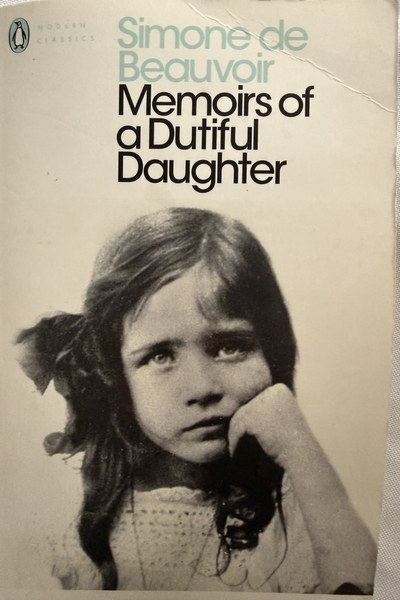
Memoirs of a dutiful daughter by Simone de Beauvoir
The book is appropriately divided into 4 books, each representing a phase of her life - childhood, school, high school, and college. The first book describes a happy childhood of a curious mind - yet empathetic. The second book starts to show fromher her relationship with her parents, relatives and friends, and a teeny tiny glimpse into her ideas of the world which became great - and rightfully so - for the world. The third book starts to expound more of her ideas, rebellion against her parents, her disapproval of her father and her feminine side along with her great friendship with Zaza and Jacques. The latter was more romantic feelings than friendships. The final book shows the emergence of Simone de Beauvoir or how the ideas seeded previously in her were watered through lectures on philosophy and here friendship with ‘The Comrades’, and in particular her admiration and emergence of life-long friendships with Sartre.
Her childhood already shows glimpses of her intellectual integrity and rigorous logical observation of things around. She observed the patriarchy in her family, the conformity and traditional structure of institutions like family, and the dinner conversations between her father and grandfather about the good old times. She was thankful and comfortable in the upbringing but was very aware about her space. She did not want to be second fiddle to her parents after her sister was born, and took delight in being her leader.
Short sentences, with semi-colons to drift to other thoughts like a child always does. However, this styles wanes as the book progresses which is her skill. Her prose and literary style are well developed and have a huge influence of Sartre; probably the fruits of a 30 years relationship of admiration and devotion between peers. But her mastery lies in the fact that she displays her willingness to participate in the game and describe it as a player rather than as a coach.
The second book showcases her leadership, intellectual prowess and emotional aspect - the human side. Her intellectual prowess is best displayed in her change of views about universal suffrage. Initially in agreement with her father about it being a bad idea, she later on changes her views based on her experience and growth of knowledge. Her relationship with her father changed drastically as he read and experienced the world more with friends like Zaza and Elizabeth.
She becomes more critical of her father’s failing societal standards in the wake of his declining financial successes. Her father’s different behaviour towards elitist and the bourgeoise when he was successful changed later on. He appreciated the comradeship of the bourgeoisie more as life went on and he accepted his fate. But, he remains a central part of her life because she credits him to encouraging her to study and develop a career or become self-evident, but she also blames him for traumatising her by commenting in her ugliness at times. She does take the second comment personally, I think. While her relationship with her father is well documented as fragmented, I feel we are too harsh towards her father or might have to take another look at it. She could probably sense that her father had seen her greatness and lamented the fact that schools and universities did not encourage female students or careers, and so he inhibited his own expectations by criticising her.
Her description about how her father although an anti-feminist had always encouraged her to read and write, and pursue ambition probably pushed her to succeed more about of tribute to him than as a rebellion. He probably lamented his own inadequacy in realising his prodigious daughter’s full potential. We will never know for sure, but I come to this opinion frommy own experience. My parents and my grandparents had warned me that in my pursuit of intellectual integrity it will be difficult for me to meet people and make friends.
The title of the book suggests she had more respect for her parents than the world deems fromher writing. Probably 15 years after adopting Sylvie she understands parenthood better. Or maybe the name is sarcastic and I am plain wrong.
Her story and life tells me she probably belonged to the upper middle if not the upper class of society. Probably, because of her father’s comments, she always doubted her beauty and was always looking up to more beautiful women as role models or seeking their friendships as evidenced in the way she described her relationship with Elizabeth and her good friend Zaza.
Her friendship with Zaza is beautiful and human. They grow through a lot and she - I believe - was her closest friend before Sartre came into her life. It is also the irony of time, that Sartre’s entry into her life was nearly at the same time as Zaza’s death. Never to be the second fiddle - except to maybe Sartre -, Simone played so many roles for Zaza - her friend, sister, and at times mother too. She did risk the wrath of societal norms by arranging secret meetings of Zaza with Pladelle, and was disappointed to the point of angry at Zaza when the latter turned down marriage as an option. I felt a tinge of regret in Simone’s writing when she realised how unaware she was about Zaza’s true mental condition.
She had a fondness for the richness of life and always sought company of either rich families - Zaza, Elizabeth, Jacques, - or of people deemed to be successful like Sartre and the comrades. Nevertheless, she had a confidence in her and her understanding of the worldliness that I can relate to. Her brazen confidence and lack of regards for authority was evident fromthe beginning. Her teachers had seen a well behaved kid changed into an unruly person in the final years of her school, and had blamed her friend Zara’s influence for its change. But the truth couldn’t be more diverse.
Book three also reveals more of her relationship with Jacques and gives us a glimpse of how young men of that era behaved. Personally, I find the youth behaviour similarity to contemporary times - bragging, fast cars, showing off, and drinking. However, she also reveals her funnier side or her attempt to fit in and please people in her episodes fromthe bars and nightlife. So, she was normal too. She does share more of her romantic dreams and feelings, and her on-off relationship with Jacques. She is starting to become a woman more in this part of the book and sounded normal and mundane just like all of us. What stands out is how she and Zaza were willing to marry their cousins.
She was determined to compensate for her self-deemed ugliness by working hard, securing good grades and becoming a teacher. She wanted out of these traditional institutionalised thinking - get married, have kids, etc. She was influenced by Mary Scott’s books and was abetted by her belief that she would be able to fend for herself in this world. She demonstrated this when she was studying philosophy at Sorbonne with a lot of male students and a handful of females.
She candidly mentions how they treated her equally and nothing special or fromresentment barring the one person who avoided talking to her. Later in book four she mentions how after gaining entry into Sartre’s inner circle, she observed how nobody interrupted him or challenged him, and she was the first one to engage him in a discussion. It was evident frombook one and her interactions with her father who did dote on her as a child. She never used the wings of victimhood to fly, but her audacious curiosity and an idealistic belief in her ideas.
It is her firm belief in her ideas almost to the point of no compromises that gives her ideas the soul for which one could die for. While contemporary thinking deems communism as extreme liberalism she questioned that too - probably more fromher own personal experience of being judged by a Chinese friend. Her friend deemed that only people who had experienced hunger had right to liberalism and judged her for being a pseudo-liberal. Her idealism comes forth in the fact that she discarded this friendship quite soon after this incident.
Her idea of liberalism is reason and logic over traditional and institutionalised thinking. She was not the pretentious left wingers who would publish liberal thinking magazines under funding fromtheir rich fathers. Similarly she was also critical of socialism as liberal, and posed a thought - how can socialism be liberalism because it provides the basic comforts of life that eliminate or reduce reasonable thinking.It was her core belief in existentialism that freedom exists in the mind and thoughts that she brings forth in the book.
Book four shows her relationship with philosophy and her friendship with the ‘comrades’. It’s also about her feminism - not to plead but to prove. She does this consistently. The highlight fromthis book is the beginning of her relationship with Sartre. She initially was befriended by a married person fromthe comrades but as time went on and Sartre allowed her in the circle, she was probably awestruck by his genius initially. At how humble he was and how he believed in his own non-indetity which is in conflict fromwhat Sartre writes about himself in Words.
But, I believe her statement or revelation that she admired or loved or got closer to Sartre is because he let her be, let her talk, let her say things without judging her or putting her on the moral standards or evaluation of the world. He understood or tried to understand herself as her, not someone else. I believe this is applicable to all humans, and beautiful relationships where two people can be and express themes without feeling imprisoned in the cage of other’s expectations.
It’s an amazing book where intellect and emotions both thrive in the presence of each other and encourage without demeaning either.