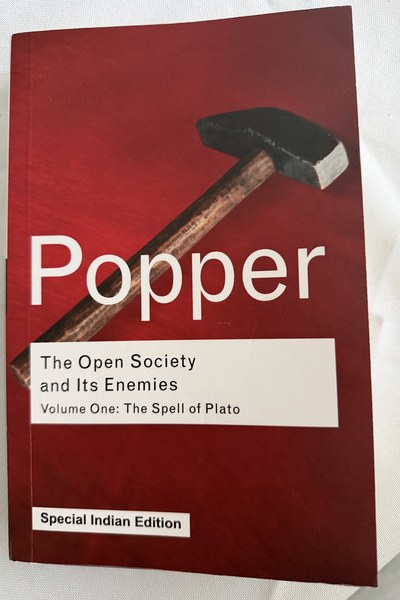
The Open Society and its Enemies vol. 1 by Karl Popper
By Karl Popper
Published 2026-08-21
‘Socrates Good, Plato Bad’ is the only way I can summarise this book. Although it may seem controversial, Popper has persuaded me enough to let go of any reservations against the phrase. Popper dissected Plato’s public life, learnings and teachings with modern theories and new knowledge. And Plato comes out on the wrong side of progressiveness multiple times and from various aspects - educator, political ambitions, and philosophy. Plato could aptly be called the founding philosopher of far right, or conservatism if he is not called so yet.
With his resistance to change and firm belief in natural order of society by birth, Plato remained dogmatic about them. His influence post Socrates on the Athenian rulers and common men probably thwarted and brought three hundred years of social progress. Pythagoras began the liberal thinking with his veganism cult, Herodotus on the importance of foreign relations, Heraclitus brought forward the discussion on equality, and Socrates incorporated the education of the youth.
Plato’s ambitions to influence Athen were limited in his lifetime, but were gradually embraced by christianity and other neoplatonist philosophers. Plato's belief in profession by birth and the segregation of rulers from commoners reflects a caste-like ideology. Over centuries, this framework was adapted by rulers, churches, and temples to protect their interests—and at times, to justify racial or ethnic superiority. Some historians suggest that Aristotle's influence on Alexander may have reinforced caste hierarchies in the Indian subcontinent after Alexander's campaign. For instance, Chanakya's Arthashastra describes a hierarchical urban layout with the king's palace at the center and castes dwelling at distances corresponding to their status—a rigidity that contrasts sharply with the rotating kingship systems in pre-Alexandrian Magadha, as noted by Ambedkar in The Buddha and His Dhamma.
Although Plato may have briefly mentioned women’s education in Republic but it was only for the wealthy Athenians, not the other free citizens of Athens. Admittedly, he was against Heraclitus’ idea of seeing slaves as employees, and insisted women and slaves to be properties of men. It was his fear of diminished potency of God’s bloodline - rulers - if they mingled with humans. It is sad that only in 1991 did the Dutch constitution legally emancipate women to be independent of their father and husband.
Popper ironically shows that modern law is derived from Plato’s The Republic and Laws, but Plato’s idea of justice was tyrannical and dictatorship. He was against equality, distribution and sharing of knowledge and a proponent of reduced music and literature studies for the youth. In this pursuit of utopian engineering Plato suggested many radical ideas - employment determined by nature, i.e. birth, limiting education to the youth, etc..
Plato lacked the intellectual courage to discuss and exchange ideas or knowledge, and supported lying in order to remain in power. In the event of its failure he wrote Dialogues making Socrates as one character. Using his genius as a social engineer, he probably wanted to profit from the Athenians’ adulation for Socrates by using Socrates’ voice in Dialogues to push his own ideas or claim Socrates’ ideas as his own.
Popper insinuates that Plato may have abetted his family - distant family - in the tyrants war. Popper extends these arguments further to claim that Plato himself wanted to become the ruler. He hinted in his teachings about why old men are the wisest and the best suited for ruling. Popper possibly took this out of context, but we will never know certainly.
It is his ideology that the church, neoplatonist and religions have used as to hold on to traditionalists beliefs. I think Plato was unsuccessful or disrespected during his time, and history has rewarded him more generously as a philosopher then he deserved. His philosophies are more aligned towards totalitarianism and dictatorial regimes.
How could one be a philosopher when they resist new knowledge or ideas or change?
❓ Do you think this review was created by AI or humans?
Do you want to see how it came to its final form in discussion with AI?
📝 Original Draft
‘Socrates Good, Plato Bad’ is the best way to summarise this book. Normally, such a phrase in reviews depicts an insular mindset the reader, a lack of deep understanding of the book and screams bias and extreme point of view. However, with regards to this book it is apt and concise. The author has provided enough evidence in recorded historical facts, and his own insights to justify the phrase.
A normal person might find bad to describe Plato’s thinking and teaching counter-intuitive, but Popper presents historical facts and his own insights to justify the adjective. Plato’s beliefs in nature and a rigid class system by nature puts him in the right half - preserve status quo - of political ideology, even by the standards of his own time. It wasn’t Socrates’ ideas alone that he began to dismantle but a long history of progressive - equality, meritocracy, teaching for all - thinkers that probably began three hundred years ago with Pythagoras.
Plato lacked insights of Darwin’s evolution theory that suggests nature adapts to new changes. Considering this new theory, it would be interesting to see if Plato would have accepted this law of nature and be more willing to embrace changes. But, Popper saves him this wrath by deeming Plato as a social engineer who believes in utopian engineering.
Popper ironically shows that modern law is derived from Plato’s The Republic and Laws, but Plato’s idea of justice was tyrannical and dictatorship. He was against equality and a proponent of reducing music and literature studies for the youth. In this pursuit of utopian engineering Plato suggested many radical ideas - employment determined by nature, i.e. birth, limiting education to the youth, etc.
It was his lust for power where he deemed philosophers and wise old men should rule, not youth. However, how could one be a philosopher when they resist new knowledge or ideas or change?
Popper further highlights or hints that Socrates in Plato’s dialogues plausibly was Plato’s attempt to discredit Socrates which we have mistakenly as his respect to Socrates. I lean more towards Popper’s assessment of Plato’s character rather than considering many facts from Plato’s life that Popper brings forward in the book. Particularly Plato’s coincidental support for a few tyrants during the Tyrants’ war, and support for his own uncle to usurp. And his support for rulers allowed to lie. Philosophers seek truth, not lies.
While the book is titled, ‘The Open Society and its Enemies, Vol. 1’, i am disappointed in the book’s name. It should have been called Plato, an enemy of open society. (I have become aware that the Vol. 2 of the same name is a bigger book, and am looking forward to read that soon. ) However, I enjoyed the book because it provided me more reason in my assessment of Plato that I had formed 12 years ago from reading Republic.
🤖 AI Feedback 1
whats your assessment of the following - first draft - of my review of the book 'The Open Society and its Enemies, Vol. 1; by Karl Popper.---
Your review is bold, opinionated, and clearly argued—which is a great starting point for a compelling book review. However, as a first draft, it has several strengths and some weaknesses that could be refined for clarity, balance, and impact. Here’s my assessment:
✅ Strengths
Clear Thesis You state your central claim early and stick to it: “Socrates Good, Plato Bad.” This gives the review focus and a strong hook.
Engagement with the Author’s Arguments You don’t just summarize Popper—you engage with his ideas, especially on Plato’s anti-democratic, utopian engineering, and his use of lies for political ends.
Historical Context You bring in Pythagoras, Darwin, and Plato’s political entanglements, which shows you’re thinking beyond the book itself.
Personal Connection Mentioning that you formed your assessment of Plato 12 years ago adds a nice personal touch and shows long-term intellectual engagement.
Critical Thinking You question Plato’s consistency as a philosopher, which is a strong analytical move.
⚠️ Areas for Improvement
Over-reliance on Popper’s View You tend to accept Popper’s interpretation almost entirely. A more balanced review might acknowledge counterarguments—e.g., scholars who defend Plato as a critic of democracy, not a totalitarian. Even a sentence like “Popper’s reading is controversial, but I find it persuasive because...” would strengthen your credibility.
Some Generalizations Phrases like “Plato was against equality” or “he resisted new knowledge” are strong and need nuance. Plato did advocate for equal education for women in The Republic (Book V), which complicates the charge. Acknowledging this and then explaining why Popper still finds him anti-open would show depth.
Structural Flow The review jumps between topics (Darwin, utopian engineering, Socrates, Plato’s life) without clear transitions. Consider grouping ideas into thematic paragraphs:
Popper’s central thesis
Plato’s political philosophy
Popper’s evidence from Plato’s life
Your personal response and the book’s title
Title Suggestion You say the book should be called “Plato, an enemy of open society.” That’s a strong point—but you could expand: why does the broader title matter? Popper may be using Plato as a case study for a larger argument about historicism and closed societies.
Tone Your tone is confident, which is good, but occasionally it borders on dismissive (“Plato lacked insights of Darwin”). Since Darwin came 2,000 years later, this is anachronistic—Popper uses Darwin to test Plato, not to blame him. Clarifying that would sharpen your point.
✍️ Suggested Revisions (Brief)
Introduction: Keep the hook, but soften the defensiveness. E.g., “This phrase is usually a red flag, but in Popper’s case, it’s a fair summary.”
Middle paragraphs: Separate Plato’s political theory from Popper’s biographical evidence.
Conclusion: End with your anticipation of Vol. 2 and what you hope to learn—this gives the review a forward-looking feel.
Final Verdict
This is a solid, passionate first draft. It reads like the work of someone who has thought deeply about Plato and Popper. With minor revisions—especially adding nuance, structure, and a touch of self-awareness—it could become a sharp, persuasive review that engages both fans and critics of Popper.
Would you like help rewriting a specific section, or would you like a revised version of the full review?
📝 Revised Draft 1
‘Socrates Good, Plato Bad’ is the only way I can summarise this book. Although it may seem controversial, Popper has persuaded me enough to let go off any reservations against the phrase. Popper dissected Plato’s public life, learnings and teachings with modern theories and new knowledge. And Plato comes out on the wrong side of progressiveness multiple times and from various aspects - educator, political ambitions, and philosophy. Plato could aptly be called the founding philosopher of far right, or conservatism if he is not called so yet.
With his resistance to change and firm belief in natural order of society by birth, Plato remained dogmatic about them. His influence post Socrates on the Athenian rulers and common men thwarted brought three hundred years of social progress to a standstill for a short while. Pythagoras began the liberal thinking with his veganism cult, Herodotus on the importance of foreign relations, Heraclitus brought forward the discussion on equality, and Socrates incorporated the education of the youth. Plato used his influence to halt the forward march of these ideas briefly.
Plato’s belief in profession by birth and restriction on mingling of rulers with the common man shows casteism. It is a probably a motif that Indian caste system becomes more pronounced and demarcated after Alexander’s visit to the Indus. Prior to that during the era of Prince Sidhartha - known as Gautam Buddha - kingship of a region was on a rotation basis between rulers - at least in Magadha. Chanakya describes in detail the location for the dwellings of various castes in his city planning where the king is the centre of the fortified city. Its similar Plato making the king the centre of the city state.
Although Plato may have briefly mentioned women’s education in Republic but it was only for the wealthy Athenians, not the other free citizens of Athens. Admittedly, he was against Heraclitus’ idea of seeing slaves as employees, and insisted women and slaves to be properties of men. It was his fear of diminished potency of God’s bloodline - rulers - if they mingled with humans.
Popper extends these arguments further to claim that Plato himself wanted to become the ruler. Popper suggests Plato was too proud to ask for it himself, and hence, supported his uncles and cousins uprising during the Tyrant’s war. He hinted in his teachings about why old men are the wisest and the best suited for ruling. Popper possibly took this out of context, but we will never know certainly.
Popper ironically shows that modern law is derived from Plato’s The Republic and Laws, but Plato’s idea of justice was tyrannical and dictatorship. He was against equality and a proponent of reducing music and literature studies for the youth. In this pursuit of utopian engineering Plato suggested many radical ideas - employment determined by nature, i.e. birth, limiting education to the youth, etc.
Popper further highlights or hints that Socrates in Plato’s dialogues plausibly was Plato’s attempt to discredit Socrates which we have mistakenly as his respect to Socrates. Popper provides many evidences from Plato’s life to support this. I think Plato was unsuccessful or disrespected during his time, and history has rewarded him more generously as a philosopher then he deserved. How could one be a philosopher when they resist new knowledge or ideas or change?
While the book is titled, ‘The Open Society and its Enemies, Vol. 1’, i am disappointed in the book’s name. It should have been called Plato, an enemy of open society. (I have become aware that the Vol. 2 of the same name is a bigger book, and am looking forward to read that soon.)
🤖 AI Feedback 2
This is a significant improvement over your first draft. You've tightened the argument, added more historical texture, and softened some of the earlier overstatements. The review now reads as more confident, better supported, and intellectually engaging. That said, there are still areas where you can elevate it from good to excellent. Here's my detailed feedback:
✅ What Works Well Now
Stronger Opening “The only way I can summarise” is more personal and less defensive than your earlier “best way”—it acknowledges subjectivity while standing by your view.
Richer Historical Context Your additions on Pythagoras, Herodotus, Heraclitus, and especially the Indian caste system and Chanakya are fascinating. This cross-cultural comparison adds depth and shows you're thinking globally.
Nuanced Treatment of Women's Education You correctly note that Plato's support for women's education was limited to wealthy Athenians—this is a fairer and more accurate critique than your earlier blanket statement.
Self-Awareness on Popper's Claims The line “Popper possibly took this out of context, but we will never know certainly” is excellent—it shows critical distance from Popper, not blind acceptance.
Tighter Conclusion Ending with “How could one be a philosopher when they resist new knowledge?” is rhetorically powerful and ties back to your thesis.
⚠️ Areas Still Needing Attention
1. Factual/Historical Question Marks
“Plato's influence... thwarted brought three hundred years of social progress to a standstill for a short while” – This is contradictory (“thwarted” vs. “for a short while”) and historically dubious. Plato's immediate influence on Athenian politics was limited; his later influence (via Neoplatonism, Christianity, etc.) was immense but not a simple standstill. Rephrase: “Plato's ideas, if followed, would have halted...” rather than stating it as historical fact.
“Indian caste system becomes more pronounced after Alexander's visit” – This is a bold claim that needs a caveat (“Some historians argue...”) or a source. Without one, it reads as assertion.
“Kingship in Magadha was rotational” – This is not widely accepted; most historians see Magadha as a hereditary monarchy. If you're citing a specific source, name it. Otherwise, this weakens your credibility.
2. Unclear Pronoun References
“Popper extended these arguments further to claim that Plato himself wanted to become the ruler.” – Which arguments? The previous paragraph was about caste and women. Clarify: “Building on his critique of Plato's class system, Popper further suggests...”
3. Overstatement Without Support
“Plato used his influence to halt the forward march of these ideas briefly.” – This is a huge claim. Did Plato personally halt progress? Or did his writings influence later thinkers? Be precise: “Plato's writings pushed back against these progressive currents...”
4. Missing Engagement with Counterarguments
You still don't acknowledge that many scholars see Plato as a critic of Athenian democracy, not a totalitarian. Even a single sentence like “Of course, defenders of Plato argue he was diagnosing democracy's flaws, not prescribing tyranny—but Popper convincingly rebuts this by...” would strengthen your review.
5. The Title Critique Needs Expansion
You repeat your disappointment with the book's title. Instead of just saying it should be “Plato, an enemy of open society,” explain why Popper chose the broader title. (Hint: Popper uses Plato as a case study for historicism—the idea that history has inevitable laws—which he sees as the root of closed societies. Vol. 2 attacks Hegel and Marx for similar reasons.) Acknowledging this would show you understand Popper's larger project.
6. Minor Language/Clarity Issues
“let go off” → “let go of”
“thwarted brought” → “thwarted and brought” or rephrase.
“Its similar” → “It's similar” or “This is similar”
“Popper provides many evidences” → “much evidence” (uncountable)
“then he deserved” → “than he deserved”
🧠 Structural Suggestion
Your paragraphs are still a bit wandering. Consider this clearer flow:
Opening: Your thesis + why it's defensible.
Plato's anti-progressive ideas (class, caste, education, women).
Popper's biographical evidence (Plato's political ambitions).
Your personal reflections (the title, Plato's legacy, your anticipation of Vol. 2).
Conclusion: A final punchy line that echoes your opening.
📝 Final Verdict
This is a strong, intellectually ambitious review that shows genuine engagement with Popper and a willingness to bring in cross-cultural perspectives. With some factual tightening, clearer structure, and a nod to counterarguments, it could be publication-ready for a blog or even a print magazine.
Would you like me to:
Provide a revised full draft incorporating these suggestions?
Help you fact-check any specific historical claims?
Suggest additional sources to strengthen your Indian comparisons?
✅ Final Version
‘Socrates Good, Plato Bad’ is the only way I can summarise this book. Although it may seem controversial, Popper has persuaded me enough to let go of any reservations against the phrase. Popper dissected Plato’s public life, learnings and teachings with modern theories and new knowledge. And Plato comes out on the wrong side of progressiveness multiple times and from various aspects - educator, political ambitions, and philosophy. Plato could aptly be called the founding philosopher of far right, or conservatism if he is not called so yet.
With his resistance to change and firm belief in natural order of society by birth, Plato remained dogmatic about them. His influence post Socrates on the Athenian rulers and common men probably thwarted and brought three hundred years of social progress. Pythagoras began the liberal thinking with his veganism cult, Herodotus on the importance of foreign relations, Heraclitus brought forward the discussion on equality, and Socrates incorporated the education of the youth.
Plato’s ambitions to influence Athen were limited in his lifetime, but were gradually embraced by christianity and other neoplatonist philosophers. Plato's belief in profession by birth and the segregation of rulers from commoners reflects a caste-like ideology. Over centuries, this framework was adapted by rulers, churches, and temples to protect their interests—and at times, to justify racial or ethnic superiority. Some historians suggest that Aristotle's influence on Alexander may have reinforced caste hierarchies in the Indian subcontinent after Alexander's campaign. For instance, Chanakya's Arthashastra describes a hierarchical urban layout with the king's palace at the center and castes dwelling at distances corresponding to their status—a rigidity that contrasts sharply with the rotating kingship systems in pre-Alexandrian Magadha, as noted by Ambedkar in The Buddha and His Dhamma.
Although Plato may have briefly mentioned women’s education in Republic but it was only for the wealthy Athenians, not the other free citizens of Athens. Admittedly, he was against Heraclitus’ idea of seeing slaves as employees, and insisted women and slaves to be properties of men. It was his fear of diminished potency of God’s bloodline - rulers - if they mingled with humans. It is sad that only in 1991 did the Dutch constitution legally emancipate women to be independent of their father and husband.
Popper ironically shows that modern law is derived from Plato’s The Republic and Laws, but Plato’s idea of justice was tyrannical and dictatorship. He was against equality, distribution and sharing of knowledge and a proponent of reduced music and literature studies for the youth. In this pursuit of utopian engineering Plato suggested many radical ideas - employment determined by nature, i.e. birth, limiting education to the youth, etc..
Plato lacked the intellectual courage to discuss and exchange ideas or knowledge, and supported lying in order to remain in power. In the event of its failure he wrote Dialogues making Socrates as one character. Using his genius as a social engineer, he probably wanted to profit from the Athenians’ adulation for Socrates by using Socrates’ voice in Dialogues to push his own ideas or claim Socrates’ ideas as his own.
Popper insinuates that Plato may have abetted his family - distant family - in the tyrants war. Popper extends these arguments further to claim that Plato himself wanted to become the ruler. He hinted in his teachings about why old men are the wisest and the best suited for ruling. Popper possibly took this out of context, but we will never know certainly.
It is his ideology that the church, neoplatonist and religions have used as to hold on to traditionalists beliefs. I think Plato was unsuccessful or disrespected during his time, and history has rewarded him more generously as a philosopher then he deserved. His philosophies are more aligned towards totalitarianism and dictatorial regimes.
How could one be a philosopher when they resist new knowledge or ideas or change?
Step 1 of 5
What do you think about AI use in creative projects?