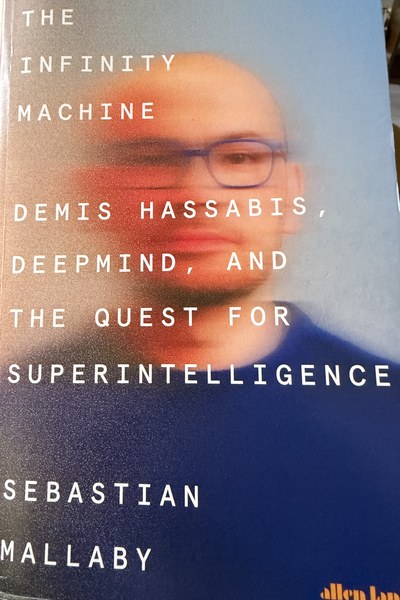
The Infinite Machine: Demis Hassabis, DeepMind, and the Quest for Superintelligence by Sebastian Mallby
By Sebastian Mallby
Published 2026-09-27
Narcissistic minds show their true colours when faced with challenge of scaling a complex and unwanted solution for society’s problems. Their romance with idealism takes a backseat and practical matters of preserving their ego takes front seat. In projecting themselves as angels, they throw their guardians away without remorse. Narcissism has many faces from the openly honest Jobs about it to the ones who want to be always liked despite their narcissism like Hassabis and Musk.
Mallby has done a brilliant job at masking or subverting Hassabiss’narcissism through out the book. It begins as usual with how most geniuses have hard childhoods but show signs of genius. The parents are then sold on this genius by an expert from the field, and the parents start to make sacrifice for the child to achieve his potential. Chess was Hassabis’ genius and his father driving in his camper van was the sacrifice.
Its the cliche of modern day geniuses who want their biographies written before they die to defend their little egos from the criticism which arise in biographies written after they die. Their pettiness to sound and belong to humble and normal people, to give us mere normal hope that it can be done.
The genius gets obsessed with gaming and puts his mind into it like every other genius did. His creative mind pushes the gaming industry’s limitations and also brings him in touch with coding which he falls in love with. His boss adores him but his ego has flown to higher grounds. Hence, he decides to pursue higher studies at Cambridge, and rightfully so. Intellectual curiosity can never be satisfied in the humdrums of business shops.
Only a true scientist appreciates the joy of his idea stress-testing the rigours of an intellectual pipeline before its crafted into a thesis. A salesman can never achieve that joy, and I relate to Hassabis when he proudly - and hopefully truthfully - claims to Mallaby in a video call that he would not swap his Nobel prize medal even for ten billion dollars. I use the phrase - hopefully truthfully - because from the book I concluded that Mallaby’s entrepreneurial side won over his scientist side way before the Nobel prize was awarded to him.
As he walked the corridors of Cambridge and gulped beer wit Silver during those days discussing knowledge in its purest form - its pursuit, significance, irrelevance at times and over importance at others, I was captivated by his personality. But, he seemed to good to be true. Anyone who starts to compare or say he wants to be Einstein has no idea of who Einstein was as a person, as a scientist and as a Human.
Einstein willingly joined a protest against the use of nuclear warheads in Japan when he became aware that Japan was about to surrender - Issacson’s biography on Einstein - and put his reputation at stake. He signed he letter to stop the use of nuclear weapons even though six years earlier he had urged the US to accelerate development of nuclear weapons s0 that they can have it before Germany. Einstein tried to refute Bohr’s statistical understanding of quantum mechanics by thought experiments, maths and data not race him to the theory’s final push. He let it rest when he couldn’t refute it anymore, and that is what a true scientist does - change his opinion in view of new facts, something I believe Hassabis couldn’t dare to even comprehend when OpenAI broke safety protocols.
At Cambridge, Hassabis realises that he prefers to be an entrepreneur and wants to build an AI system. He asks Silver to join him and brainstorms with his younger brother’s friend’s brother -Suleyman (the guardian angel). He wants to bring Suleyman onboard the DeepMind and Suleyman is interested too but wants to be a co-founder. Hassabis is reluctant but agrees to it citing is priority is the scientific development of DeepMind.
With Suleyman’s entry into DeepMind, a business starts to develop - networking, capital raising, practical ideas and testing. It takes the book along the dark alleys of business development and the intricacies of Silicon Valley quirks working with the assumedly “shy” and “polite” Britishers in their British backyard.
As Mallaby’s takes us on this journey I realised Hassabis’ is always lingering around when success is guaranteed - the negotiations with Elon Musk and Google, the price boost of Hinton’s acquisition by Google, - but his shadow is missing when failure occurs - NHS fiasco, negotiation with Pichai after he became the CEO, and the internal fiasco at DeepMind.
Suleyman also had a tough childhood and was idealist. He saw the potential of DeepMind for societal benefits and wanted its benefits to come to the common man. That’s why he pushed for collaboration with NHS and single handedly tried to resolve the problem of report deliveries in time. I can imagine its trivial in 2026 but at the time of the incident it must have been difficult because cloud computing at a massive scale was still in its infancy.
Suleyman gains more respect than Hassabis in his outlook and benevolence towards humanity because he single-handedly challenged Google or fought against DeepMind’s tool being used in wars. That’s admirable, noble and a true activist. But, like all guardian angels, he was thrown under the bus in an internal fiasco at DeepMind.
The bullying and controlling accusations against Suleyman are not trivial. They should have been dealt with and were rightfully investigated privately so that Suleyman’s reputation wasn’t destroyed. When the findings came out, Suleyman also took the practical choice and asked for the anger management route and to be re-instated later on. However, to his disappointment the return was short lived and he went to Google as a VP, or let’s say he was put on garden leave. However, he does do well later on at Microsoft.
These incidents and Suleyman’s time at DeepMind throw a good insight into Hassabis’ personality. He doesn’t want to face the consequences of his action, ambition and would go to any length to protect his own image, ideals and portray himself as a genius. While Mallaby spends time on Suleyman we hear nothing on Silver and his role at DeepMind except for a few paragraphs which I feel are randomly inserted.
I feel the author feels indebted and let’s Hassabis self-narrate his own hard times. From the tough negotiations with Google in Project Mario, Hassabis narrates his frustration at the delays, given up and returning to Science. But, he claims to be the brain behind propping up Hinton’s valuation to Google so that he can be of more value. This valuation boosting is from a person who claims to be simple and have no expensive pleasures.
It irks me that geniuses try to be relatable to the common man by using these caveats of driving a ten years old Audi and not owning any second homes. Hassabis claims they are in the family member's name. Mallaby let’s him off the hook and doesn’t probe further - how did his family members get them? Is it to avoid taxes, etc.? This is similar to not probing Hassabis about the leak of Suleyman’s exit story to Bloomberg. Hassabis’ control on the book is evident because we never hear about Suleyman’s side in these incidents. Contrast this to Isaacson’s book on Jobs where we hear from Wozniack and even his rival Bill Gates.
I found it hard to believe that Hassabis wasn’t tempted by greed to pursue his HFT systems, and on failure simply brushed it aside as an intellectual pursuit. He doesn’t go in depth for his HFT project because it failed, while Jobs talked about his failures as learning lessons. And so does Buffet who named his investment company after one of his biggest failure.
How can a person be planning for humanity’s wellbeing not take feedback or criticism? This brings us to what I found the most interesting part in the book from both technology aspect of AI, but also insights into Hassabis’ controlling personality. This section is where the book’s technical and political threads finally meet their financial motivations - and also AI’s.
It’s nice to see how something I use almost on a daily basis came into being from so many different aspects. The growth of Large Language Models (LLMs) from simply predicting the next word based on statistics to its current stage had many stages of development before it came to become so ubiquitous in the previous four years.
It is Hassabis’ scientific and creative genius that he was the earliest thinkers of brining single agentic thinkers together to form a system of multi-agents. The network thus formed came to be known as neural networks. I was most excited to read this section in the book to see how it was all applied, and how when scientists put their egos aside and collaborate we can resolve a lot of crisis. It was progressive thinking in small steps that brought us here, not a giant like Einstein thinking alone
And it irritated me to see how their egos eventually also accelerated the risk of human existentialism. Or are they exaggerating it?
Ten years ago when Musk lost his bid for DeepMind to Google, he asked stories to be planted about how AI would accelerate human existential risk. He wanted to be the forefather or the leader in AI industry and its development for humanity. Like a child who wants to destroy things he can’t have, Musk moved in that direction. Recently, we have same murmurs about AI going rogue as western AI companies lose to Chinese AI companies in terms of computing costs.
He then found solace in collaborating with Altman in creating the non-profit OpenAI. Together, they poached the best minds of AI - Sutskever, Dario Amodei, etc. - and made the right noises about AI along with DeepMind - safety boards, transparent collaboration with the government agencies. Everything seemed right but then egos took over. Musk and others couldn’t contain Altman’s ambition to accelerate AI.
Altman wanted to become God because he may have felt like a mortal amongst people whose name have been etched in tech history - Musk with SpaceX and TSLA, Hinton with his Nobel prize, Hassabis with DeepMind. And so he tried to become God at the cost of humans, but that’s what every God tries using the scale of more benefits against less risk. And against all warnings and safety, he released GPT4.0 to the world.
Networks crashed, memes originated, poems were written and human evil wasn’t to be left behind so it showcased itself too.
This become a pivotal point in AI history and Hassabis’ who confesses Einstein to be his idol fails to emulate him. He joins the race and starts to accelerate AI saying,’If not him, someone else will’ - the convenience excuse of most evil minds in the world. Yes, I deliberately use the word evil. A moral and right mind abdicates but an evil mind holds on to power at all costs.
I think Hassabis wanted to control AI absolutely and be its lead/apex focal point but when he started to lose ground - and as usual the mask comes off under pressure - his smooth sailing became a bumpy ride which coincided with Suleyman's exit, etc. when he had new ideas that weren’t his own he couldn’t steer the ship collaboratively it feels and he started to blame others. Story planted/leaked to Bloomberg about Suleyman’s exit is quite suspicious.
Hassabis has tried really hard to push the shortcomings of AI or whenever it failed towards Google's behemoth structure, Hinton's students and Altman's acceleration without respecting safety protocols. So yeah, this is more a mouthpiece for Hassabis even though his achievements and genius cannot be ignored. Thats not a good scientist but a egoist scientist because a good scientist seeks solutions in steps. Its only his ego that wants to put a Large Hadron Collider (LHC) in space where as it already takes so much effort to run on the earth itself.
‘What is the book's central subject - Hassabis or AI?’It has drifted in the end towards a generic AI discussion and blaming Sam Altman and OpenAI for the risky acceleration. I agree Sam Altman isn’t trust worthy, but later in the last chapter Hassabis' attempt to paint himself as a saint and a genius is so cringe. He says he needed to exercise power to get things done and manage his team, but isn’t that what every dictatorial mindset does? Atleast Jobs didn’t justify his mis-behaviour and presented his inner thinking of him being curious whenever he came across something interesting.
❓ Do you think this review was created by AI or humans?
Do you want to see how it came to its final form in discussion with AI?
📝 Original Draft
Narcissistic minds show their true colours when faced with challenge of scaling a complex and unwanted solution for society’s problems. Their romance with idealism takes a backseat and practical matters of preserving their ego takes front seat. In projecting themselves as angels, they throw their guardians away without remorse. Narcissism has many faces from the openly honest Jobs about it to the ones who want to be always liked despite their narcissism like Hassabis and Musk.
Mallby has done a brilliant job at masking or subverting Hassabiss’narcissism through out the book. It begins as usual with how most geniuses have hard childhoods but show signs of genius. The parents are then sold on this genius by an expert from the field, and the parents start to make sacrifice for the child to achieve his potential. Chess was Hassabis’ genius and his father driving in his camper van was the sacrifice.
Its the cliche of modern day geniuses who want their biographies written before they die to defend their little egos from the criticism which arise in biographies written after they die. Their pettiness to sound and belong to humble and normal people, to give us mere normal hope that it can be done.
The genius gets obsessed with gaming and puts his mind into it like every other genius did. His creative mind pushes the gaming industry’s limitations and also brings him in touch with coding which he falls in love with. His boss adores him but his ego has flown to higher grounds. Hence, he decides to pursue higher studies at Cambridge, and rightfully so. Intellectual curiosity can never be satisfied in the humdrums of business shops.
Only a true scientist appreciates the joy of his idea stress-testing the rigours of an intellectual pipeline before its crafted into a thesis. A salesman can never achieve that joy, and I relate to Hassabis when he proudly - and hopefully truthfully - claims to Mallaby in a video call that he would not swap his Nobel prize medal even for ten billion dollars. I use the phrase - hopefully truthfully - because from the book I concluded that Mallaby’s entrepreneurial side won over his scientist side way before the Nobel prize was awarded to him.
As he walked the corridors of Cambridge and gulped beer wit Silver during those days discussing knowledge in its purest form - its pursuit, significance, irrelevance at times and over importance at others, I was captivated by his personality. But, he seemed to good to be true. Anyone who starts to compare or say he wants to be Einstein has no idea of who Einstein was as a person, as a scientist and as a Human.
Einstein willingly joined a protest against the use of nuclear warheads in Japan when he became aware that Japan was about to surrender - Issacson’s biography on Einstein - and put his reputation at stake. He signed he letter to stop the use of nuclear weapons even though six years earlier he had urged the US to accelerate development of nuclear weapons s0 that they can have it before Germany. Einstein tried to refute Bohr’s statistical understanding of quantum mechanics by thought experiments, maths and data not race him to the theory’s final push. He let it rest when he couldn’t refute it anymore, and that is what a true scientist does - change his opinion in view of new facts, something I believe Hassabis couldn’t dare to even comprehend when OpenAI broke safety protocols.
At Cambridge, Hassabis realises that he prefers to be an entrepreneur and wants to build an AI system. He asks Silver to join him and brainstorms with his younger brother’s friend’s brother -Suleyman (the guardian angel). He wants to bring Suleyman onboard the DeepMind and Suleyman is interested too but wants to be a co-founder. Hassabis is reluctant but agrees to it citing is priority is the scientific development of DeepMind.
With Suleyman’s entry into DeepMind, a business starts to develop - networking, capital raising, practical ideas and testing. It takes the book along the dark alleys of business development and the intricacies of Silicon Valley quirks working with the assumedly “shy” and “polite” Britishers in their British backyard.
As Mallaby’s takes us on this journey I realised Hassabis’ is always lingering around when success is guaranteed - the negotiations with Elon Musk and Google, the price boost of Hinton’s acquisition by Google, - but his shadow is missing when failure occurs - NHS fiasco, negotiation with Pichai after he became the CEO, and the internal fiasco at DeepMind.
Suleyman also had a tough childhood and was idealist. He saw the potential of DeepMind for societal benefits and wanted its benefits to come to the common man. That’s why he pushed for collaboration with NHS and single handedly tried to resolve the problem of report deliveries in time. I can imagine its trivial in 2026 but at the time of the incident it must have been difficult because cloud computing at a massive scale was still in its infancy.
Suleyman gains more respect than Hassabis in his outlook and benevolence towards humanity because he single-handedly challenged Google or fought against DeepMind’s tool being used in wars. That’s admirable, noble and a true activist. But, like all guardian angels, he was thrown under the bus in an internal fiasco at DeepMind.
The bullying and controlling accusations against Suleyman are not trivial. They should have been dealt with and were rightfully investigated privately so that Suleyman’s reputation wasn’t destroyed. When the findings came out, Suleyman also took the practical choice and asked for the anger management route and to be re-instated later on. However, to his disappointment the return was short lived and he went to Google as a VP, or let’s say he was put on garden leave. However, he does do well later on at Microsoft.
These incidents and Suleyman’s time at DeepMind throw a good insight into Hassabis’ personality. He doesn’t want to face the consequences of his action, ambition and would go to any length to protect his own image, ideals and portray himself as a genius. While Mallaby spends time on Suleyman we hear nothing on Silver and his role at DeepMind except for a few paragraphs which I feel are randomly inserted.
Hassabis’ control on the book is also evident because we never hear about Suleyman’s side in these incidents. Contrast this to Isaacson’s book on Jobs where we hear from Wozniack and even his rival Bill Gates.
How can a person be planning for humanity’s wellbeing not take feedback or criticism? This brings us to what I found the most interesting part in the book from both technology aspect of AI, but also insights into Hassabis’ personality.
It’s nice to see how something I use almost on a d daily basis came into being. The growth of Large Language Models (LLMs) from simply predicting the next word based on statistics to its current stage had many stages of development before it came to become so ubiquitous in the previous four years.
It is Hassabis’ scientific and creative genius that he was the earliest thinkers of brining single agentic thinkers together to form a system of multi-agents. The network thus formed came to be known as neural networks. I was most excited to read this section in the book to see how it was all applied, and how when scientists put their egos aside and collaborate we can resolve a lot of crisis. It was progressive thinking in small steps that brought us here, not a giant like Einstein thinking alone
And it irritated me to see how their egos eventually also accelerated the risk of human existentialism. Or are they exaggerating it?
Ten years ago when Musk lost his bid for DeepMind to Google, he asked stories to be planted about how AI would accelerate human existential risk. He wanted to be the forefather or the leader in AI industry and its development for humanity. Like a child who wants to destroy things he can’t have, Musk moved in that direction. Recently, we have same murmurs about AI going rogue as western AI companies lose to Chinese AI companies in terms of computing costs.
He then found solace in collaborating with Altman in creating the non-profit OpenAI. Together, they poached the best minds of AI - Sutskever, Dario Amodei, etc. - and made the right noises about AI along with DeepMind - safety boards, transparent collaboration with the government agencies. Everything seemed right but then egos took over. Musk and others couldn’t contain Altman’s ambition to accelerate AI.
Altman wanted to become God because he may have felt like a mortal amongst people whose name have been etched in tech history - Musk with SpaceX and TSLA, Hinton with his Nobel prize, Hassabis with DeepMind. And so he tried to become God at the cost of humans, but that’s what every God tries using the scale of more benefits against less risk. And against all warnings and safety, he released GPT4.0 to the world.
Networks crashed, memes originated, poems were written and human evil wasn’t to be left behind so it showcased itself too.
This become a pivotal point in AI history and Hassabis’ who confesses Einstein to be his idol fails to emulate him. He joins the race and starts to accelerate AI saying,’If not him, someone else will’ - the convenience excuse of most evil minds in the world. Yes, I deliberately use the word evil. A moral and right mind abdicates but an evil mind holds on to power at all costs.
I think Hassabis wanted to control AI absolutely and be its lead/apex focal point but when he started to lose ground - and as usual the mask comes off under pressure - his smooth sailing became a bumpy ride which coincided with Suleyman's exit, etc. when he had new ideas that weren’t his own he couldn’t steer the ship collaboratively it feels and he started to blame others. Story planted/leaked to Bloomberg about Suleyman’s exit is quite suspicious.
Hassabis has tried really hard to push the shortcomings of AI or whenever it failed towards Google's behemoth structure, Hinton's students and Altman's acceleration without respecting safety protocols. So yeah, this is more a mouthpiece for Hassabis even though his achievements and genius cannot be ignored. Thats not a good scientist but a egoist scientist because a good scientist seeks solutions in steps.
I feel the author feels indebted to Hassabis and hence focusses all the negativity of AI race towards the OpenAI and conveniently hides or doesn’t share more about Hassabis actions in that time. What irks me further is why do these geniuses pretend or try to be humble even as their mask is coming off? Hassabis claims that he doesn’t own any more houses but they are in the family member's name. Isn’t that just tax evasion? Mallaby doesn’t probe this further. He doesn’t go in depth for his HFT project because it failed, while Jobs talked about his failures as learning lessons. And so does Buffet who named his investment company after one of his biggest failure.
My biggest criticism is ‘What is the book's central subject - Hassabis or AI?’It seems to have drifted in the end towards a generic AI discussion and blaming Sam Altman and OpenAI for the risky acceleration. I agree Sam Altman isn’t trust worthy, but later in the last chapter Hassabis' attempt to paint himself as a saint and a genius is so cringe. He says he needed to exercise power to get things done and manage his team, but isn’t that what every dictatorial mindset does? Atleast Jobs didn’t justify his mis-behaviour and presented his inner thinking of him being curious whenever he came across something interesting.
🤖 AI Feedback 1
here is version 1 - not a draft on the review of the book 'The infinite machine: Demis Hassabis, Deepmind and the quest for super intelligence' by Sebastian Mallaby
Conclusion: Your review is a rhetorically forceful prosecution of Hassabis's character, but it is an incomplete review of Mallaby's book. The public record shows Mallaby included material that Hassabis clearly would not have wanted published—the secret hedge fund, Project Mario, the safety philosophy collapse. The "mouthpiece" charge requires you to explain why those chapters exist.
1. The "Mallaby as Mouthpiece" Problem
Your central claim is that Mallaby "focusses all the negativity of the AI race towards OpenAI" and "conveniently hides" Hassabis's actions. But the book reportedly contains:
The secret hedge fund: Hassabis assembled ~20 researchers to build high-frequency trading algorithms without Google's approval, aiming to rival Renaissance Technologies. Google shut it down.
Project Mario: Hassabis and Suleyman spent three years trying to spin DeepMind out of Google as an independent "global interest company," with Reid Hoffman committing $1 billion. Talks collapsed when Pichai refused.
The safety reversal: By late 2022, Hassabis told Mallaby "This is wartime" and abandoned the formal governance path. He now says safety isn't about architecture—it's about "being in the room."
The Suleyman ouster: Mallaby describes Hassabis "quietly ousting" his co-founder "using the cover of a misconduct investigation where a simple discussion could have sufficed."
A mouthpiece does not include a chapter about a secret hedge fund built behind the parent company's back. A mouthpiece does not document its subject's abandonment of his founding safety condition. If Mallaby were truly servicing Hassabis's image, these sections would not exist. Your review needs to account for why they do.
2. The Suleyman Question
You claim Mallaby never presents Suleyman's side. But Mallaby interviewed Suleyman himself—he is listed among the "alienated co-founder" sources. The book reportedly draws from "Hassabis's detractors, such as his estranged cofounder Mustafa Suleyman." A review in The Wire notes that Mallaby "spoke with more than a hundred people in and out of DeepMind, from the alienated co-founder Mustafa Suleyman to the architect of AlphaGo, David Silver."
Your statement that "we never hear about Suleyman's side" appears to be factually incorrect based on the book's sourcing. It is possible you read a version that omits this material, but the burden of proof shifts to you.
3. Where Your Review Is Persuasive
Your Einstein comparison remains the strongest analytic move. Einstein publicly opposed nuclear weapons after Hiroshima, signed the letter, and abandoned his quantum mechanics objection when data defeated him. Hassabis, by contrast, told Mallaby he is "succeeding as an AI inventor while failing as an AI steward," and that the race dynamic makes unilateral slowdown "structurally difficult." Mallaby himself writes that Hassabis "concedes that the safety agenda he once championed through formal governance mechanisms has given way to something more personal."
This is not a "mouthpiece" describing a saint. It is a biographer documenting a retreat from principle. Your frustration with Hassabis's self-justification is legitimate, but it is also in the book—which weakens your claim that Mallaby hid it.
4. The Unsupported Inferences
Your review asserts:
Hassabis's property in family names "isn't that just tax evasion?" — no source supports this; it is a legal conclusion you have not substantiated.
Altman "wanted to become God" — this is psychological speculation presented as analysis.
"Hassabis wanted to control AI absolutely" — an inference from behavior, not a documented statement.
These are rhetorically effective but analytically weak. They undermine your credibility on the claims that are supported.
5. The Central Question Your Review Must Answer
If Mallaby is Hassabis's "mouthpiece," why did he write about the secret hedge fund, Project Mario, and the safety collapse? The most plausible answer is that Mallaby is not a mouthpiece—he is a sympathetic but critical biographer whose subject cooperated because the alternative (no cooperation, worse access) was worse for Hassabis's image than controlled disclosure. That is a different critique. It is more defensible. It is not the one you made.
📝 Revised Draft 1
Narcissistic minds show their true colours when faced with challenge of scaling a complex and unwanted solution for society’s problems. Their romance with idealism takes a backseat and practical matters of preserving their ego takes front seat. In projecting themselves as angels, they throw their guardians away without remorse. Narcissism has many faces from the openly honest Jobs about it to the ones who want to be always liked despite their narcissism like Hassabis and Musk.
Mallby has done a brilliant job at masking or subverting Hassabiss’narcissism through out the book. It begins as usual with how most geniuses have hard childhoods but show signs of genius. The parents are then sold on this genius by an expert from the field, and the parents start to make sacrifice for the child to achieve his potential. Chess was Hassabis’ genius and his father driving in his camper van was the sacrifice.
Its the cliche of modern day geniuses who want their biographies written before they die to defend their little egos from the criticism which arise in biographies written after they die. Their pettiness to sound and belong to humble and normal people, to give us mere normal hope that it can be done.
The genius gets obsessed with gaming and puts his mind into it like every other genius did. His creative mind pushes the gaming industry’s limitations and also brings him in touch with coding which he falls in love with. His boss adores him but his ego has flown to higher grounds. Hence, he decides to pursue higher studies at Cambridge, and rightfully so. Intellectual curiosity can never be satisfied in the humdrums of business shops.
Only a true scientist appreciates the joy of his idea stress-testing the rigours of an intellectual pipeline before its crafted into a thesis. A salesman can never achieve that joy, and I relate to Hassabis when he proudly - and hopefully truthfully - claims to Mallaby in a video call that he would not swap his Nobel prize medal even for ten billion dollars. I use the phrase - hopefully truthfully - because from the book I concluded that Mallaby’s entrepreneurial side won over his scientist side way before the Nobel prize was awarded to him.
As he walked the corridors of Cambridge and gulped beer wit Silver during those days discussing knowledge in its purest form - its pursuit, significance, irrelevance at times and over importance at others, I was captivated by his personality. But, he seemed to good to be true. Anyone who starts to compare or say he wants to be Einstein has no idea of who Einstein was as a person, as a scientist and as a Human.
Einstein willingly joined a protest against the use of nuclear warheads in Japan when he became aware that Japan was about to surrender - Issacson’s biography on Einstein - and put his reputation at stake. He signed he letter to stop the use of nuclear weapons even though six years earlier he had urged the US to accelerate development of nuclear weapons s0 that they can have it before Germany. Einstein tried to refute Bohr’s statistical understanding of quantum mechanics by thought experiments, maths and data not race him to the theory’s final push. He let it rest when he couldn’t refute it anymore, and that is what a true scientist does - change his opinion in view of new facts, something I believe Hassabis couldn’t dare to even comprehend when OpenAI broke safety protocols.
At Cambridge, Hassabis realises that he prefers to be an entrepreneur and wants to build an AI system. He asks Silver to join him and brainstorms with his younger brother’s friend’s brother -Suleyman (the guardian angel). He wants to bring Suleyman onboard the DeepMind and Suleyman is interested too but wants to be a co-founder. Hassabis is reluctant but agrees to it citing is priority is the scientific development of DeepMind.
With Suleyman’s entry into DeepMind, a business starts to develop - networking, capital raising, practical ideas and testing. It takes the book along the dark alleys of business development and the intricacies of Silicon Valley quirks working with the assumedly “shy” and “polite” Britishers in their British backyard.
As Mallaby’s takes us on this journey I realised Hassabis’ is always lingering around when success is guaranteed - the negotiations with Elon Musk and Google, the price boost of Hinton’s acquisition by Google, - but his shadow is missing when failure occurs - NHS fiasco, negotiation with Pichai after he became the CEO, and the internal fiasco at DeepMind.
Suleyman also had a tough childhood and was idealist. He saw the potential of DeepMind for societal benefits and wanted its benefits to come to the common man. That’s why he pushed for collaboration with NHS and single handedly tried to resolve the problem of report deliveries in time. I can imagine its trivial in 2026 but at the time of the incident it must have been difficult because cloud computing at a massive scale was still in its infancy.
Suleyman gains more respect than Hassabis in his outlook and benevolence towards humanity because he single-handedly challenged Google or fought against DeepMind’s tool being used in wars. That’s admirable, noble and a true activist. But, like all guardian angels, he was thrown under the bus in an internal fiasco at DeepMind.
The bullying and controlling accusations against Suleyman are not trivial. They should have been dealt with and were rightfully investigated privately so that Suleyman’s reputation wasn’t destroyed. When the findings came out, Suleyman also took the practical choice and asked for the anger management route and to be re-instated later on. However, to his disappointment the return was short lived and he went to Google as a VP, or let’s say he was put on garden leave. However, he does do well later on at Microsoft.
These incidents and Suleyman’s time at DeepMind throw a good insight into Hassabis’ personality. He doesn’t want to face the consequences of his action, ambition and would go to any length to protect his own image, ideals and portray himself as a genius. While Mallaby spends time on Suleyman we hear nothing on Silver and his role at DeepMind except for a few paragraphs which I feel are randomly inserted.
I feel the author feels indebted and let’s Hassabis self-narrate his own hard times. From the tough negotiations with Google in Project Mario, Hassabis narrates his frustration at the delays, given up and returning to Science. But, he claims to be the brain behind propping up Hinton’s valuation to Google so that he can be of more value. This valuation boosting is from a person who claims to be simple and have no expensive pleasures.
It irks me that geniuses try to be relatable to the common man by using these caveats of driving a ten years old Audi and not owning any second homes. Hassabis claims they are in the family member's name. Mallaby let’s him off the hook and doesn’t probe further - how did his family members get them? Is it to avoid taxes, etc.? This is similar to not probing Hassabis about the leak of Suleyman’s exit story to Bloomberg. Hassabis’ control on the book is evident because we never hear about Suleyman’s side in these incidents. Contrast this to Isaacson’s book on Jobs where we hear from Wozniack and even his rival Bill Gates.
I found it hard to believe that Hassabis wasn’t tempted by greed to pursue his HFT systems, and on failure simply brushed it aside as an intellectual pursuit. He doesn’t go in depth for his HFT project because it failed, while Jobs talked about his failures as learning lessons. And so does Buffet who named his investment company after one of his biggest failure.
How can a person be planning for humanity’s wellbeing not take feedback or criticism? This brings us to what I found the most interesting part in the book from both technology aspect of AI, but also insights into Hassabis’ personality.
It’s nice to see how something I use almost on a d daily basis came into being. The growth of Large Language Models (LLMs) from simply predicting the next word based on statistics to its current stage had many stages of development before it came to become so ubiquitous in the previous four years.
It is Hassabis’ scientific and creative genius that he was the earliest thinkers of brining single agentic thinkers together to form a system of multi-agents. The network thus formed came to be known as neural networks. I was most excited to read this section in the book to see how it was all applied, and how when scientists put their egos aside and collaborate we can resolve a lot of crisis. It was progressive thinking in small steps that brought us here, not a giant like Einstein thinking alone
And it irritated me to see how their egos eventually also accelerated the risk of human existentialism. Or are they exaggerating it?
Ten years ago when Musk lost his bid for DeepMind to Google, he asked stories to be planted about how AI would accelerate human existential risk. He wanted to be the forefather or the leader in AI industry and its development for humanity. Like a child who wants to destroy things he can’t have, Musk moved in that direction. Recently, we have same murmurs about AI going rogue as western AI companies lose to Chinese AI companies in terms of computing costs.
He then found solace in collaborating with Altman in creating the non-profit OpenAI. Together, they poached the best minds of AI - Sutskever, Dario Amodei, etc. - and made the right noises about AI along with DeepMind - safety boards, transparent collaboration with the government agencies. Everything seemed right but then egos took over. Musk and others couldn’t contain Altman’s ambition to accelerate AI.
Altman wanted to become God because he may have felt like a mortal amongst people whose name have been etched in tech history - Musk with SpaceX and TSLA, Hinton with his Nobel prize, Hassabis with DeepMind. And so he tried to become God at the cost of humans, but that’s what every God tries using the scale of more benefits against less risk. And against all warnings and safety, he released GPT4.0 to the world.
Networks crashed, memes originated, poems were written and human evil wasn’t to be left behind so it showcased itself too.
This become a pivotal point in AI history and Hassabis’ who confesses Einstein to be his idol fails to emulate him. He joins the race and starts to accelerate AI saying,’If not him, someone else will’ - the convenience excuse of most evil minds in the world. Yes, I deliberately use the word evil. A moral and right mind abdicates but an evil mind holds on to power at all costs.
I think Hassabis wanted to control AI absolutely and be its lead/apex focal point but when he started to lose ground - and as usual the mask comes off under pressure - his smooth sailing became a bumpy ride which coincided with Suleyman's exit, etc. when he had new ideas that weren’t his own he couldn’t steer the ship collaboratively it feels and he started to blame others. Story planted/leaked to Bloomberg about Suleyman’s exit is quite suspicious.
Hassabis has tried really hard to push the shortcomings of AI or whenever it failed towards Google's behemoth structure, Hinton's students and Altman's acceleration without respecting safety protocols. So yeah, this is more a mouthpiece for Hassabis even though his achievements and genius cannot be ignored. Thats not a good scientist but a egoist scientist because a good scientist seeks solutions in steps.
My biggest criticism is ‘What is the book's central subject - Hassabis or AI?’It seems to have drifted in the end towards a generic AI discussion and blaming Sam Altman and OpenAI for the risky acceleration. I agree Sam Altman isn’t trust worthy, but later in the last chapter Hassabis' attempt to paint himself as a saint and a genius is so cringe. He says he needed to exercise power to get things done and manage his team, but isn’t that what every dictatorial mindset does? Atleast Jobs didn’t justify his mis-behaviour and presented his inner thinking of him being curious whenever he came across something interesting.
🤖 AI Feedback 2
here you go with the edits suggested by you -
I can see the changes you've made. Let me assess the revised version.
The tax passage relocation works. Moving it next to the Project Mario section is the right call. Now it sits inside a paragraph about Hassabis's self-narration and image management, which is exactly where it belongs. It reads as evidence for a pattern rather than a stray gripe at the end. The added question—"how did his family members get them? Is it to avoid taxes, etc.?"—is framed as a probe Mallaby should have made, not as an accusation you're making. That's more defensible.
The Suleyman section is now better connected. The transition from Suleyman's ouster into "These incidents and Suleyman's time at DeepMind throw a good insight into Hassabis' personality" works because you've now placed the Project Mario material between them, so the pattern—Hassabis delegating the messy work, staying clean, letting others absorb the blow—is visible across three separate episodes rather than asserted once.
The LLM section still has the gear-shift problem. You haven't added a transition before "It's nice to see how something I use almost on a daily basis came into being." The reader is still dropped from the Suleyman/Project Mario/HFT cluster straight into technical history. It's less jarring now because you've built a longer runway of grievances before it, but the turn is still unmarked. One sentence would fix it.
What's improved overall: The review now reads less like a list of grievances and more like a cumulative case. The tax point, the Bloomberg leak, the HFT silence, and the Suleyman ouster are now clustered as evidence of the same thing—a pattern of image management—rather than scattered across the piece. The through-line about the mask slipping under pressure is stronger because the examples arrive in sequence.
What's still imperfect: The closing paragraph remains the weakest structural moment. You move from "egoist scientist because a good scientist seeks solutions in steps" straight into "My biggest criticism is..." That "My biggest criticism is" is a signal that the review is starting over rather than concluding. A revised ending would fold the "what is this book about—Hassabis or AI?" question into the body earlier, then close on the Jobs comparison and the "evil mind" line. Right now the Jobs material is doing double duty as both new argument and conclusion, which makes the ending feel like it's still building when it should be landing.
So: coherent, yes. Tightly structured, closer than before but not quite there. The changes you made are real improvements. The remaining work is one transitional sentence before the LLM section and a cleaner ending.
✅ Final Version
Narcissistic minds show their true colours when faced with challenge of scaling a complex and unwanted solution for society’s problems. Their romance with idealism takes a backseat and practical matters of preserving their ego takes front seat. In projecting themselves as angels, they throw their guardians away without remorse. Narcissism has many faces from the openly honest Jobs about it to the ones who want to be always liked despite their narcissism like Hassabis and Musk.
Mallby has done a brilliant job at masking or subverting Hassabiss’narcissism through out the book. It begins as usual with how most geniuses have hard childhoods but show signs of genius. The parents are then sold on this genius by an expert from the field, and the parents start to make sacrifice for the child to achieve his potential. Chess was Hassabis’ genius and his father driving in his camper van was the sacrifice.
Its the cliche of modern day geniuses who want their biographies written before they die to defend their little egos from the criticism which arise in biographies written after they die. Their pettiness to sound and belong to humble and normal people, to give us mere normal hope that it can be done.
The genius gets obsessed with gaming and puts his mind into it like every other genius did. His creative mind pushes the gaming industry’s limitations and also brings him in touch with coding which he falls in love with. His boss adores him but his ego has flown to higher grounds. Hence, he decides to pursue higher studies at Cambridge, and rightfully so. Intellectual curiosity can never be satisfied in the humdrums of business shops.
Only a true scientist appreciates the joy of his idea stress-testing the rigours of an intellectual pipeline before its crafted into a thesis. A salesman can never achieve that joy, and I relate to Hassabis when he proudly - and hopefully truthfully - claims to Mallaby in a video call that he would not swap his Nobel prize medal even for ten billion dollars. I use the phrase - hopefully truthfully - because from the book I concluded that Mallaby’s entrepreneurial side won over his scientist side way before the Nobel prize was awarded to him.
As he walked the corridors of Cambridge and gulped beer wit Silver during those days discussing knowledge in its purest form - its pursuit, significance, irrelevance at times and over importance at others, I was captivated by his personality. But, he seemed to good to be true. Anyone who starts to compare or say he wants to be Einstein has no idea of who Einstein was as a person, as a scientist and as a Human.
Einstein willingly joined a protest against the use of nuclear warheads in Japan when he became aware that Japan was about to surrender - Issacson’s biography on Einstein - and put his reputation at stake. He signed he letter to stop the use of nuclear weapons even though six years earlier he had urged the US to accelerate development of nuclear weapons s0 that they can have it before Germany. Einstein tried to refute Bohr’s statistical understanding of quantum mechanics by thought experiments, maths and data not race him to the theory’s final push. He let it rest when he couldn’t refute it anymore, and that is what a true scientist does - change his opinion in view of new facts, something I believe Hassabis couldn’t dare to even comprehend when OpenAI broke safety protocols.
At Cambridge, Hassabis realises that he prefers to be an entrepreneur and wants to build an AI system. He asks Silver to join him and brainstorms with his younger brother’s friend’s brother -Suleyman (the guardian angel). He wants to bring Suleyman onboard the DeepMind and Suleyman is interested too but wants to be a co-founder. Hassabis is reluctant but agrees to it citing is priority is the scientific development of DeepMind.
With Suleyman’s entry into DeepMind, a business starts to develop - networking, capital raising, practical ideas and testing. It takes the book along the dark alleys of business development and the intricacies of Silicon Valley quirks working with the assumedly “shy” and “polite” Britishers in their British backyard.
As Mallaby’s takes us on this journey I realised Hassabis’ is always lingering around when success is guaranteed - the negotiations with Elon Musk and Google, the price boost of Hinton’s acquisition by Google, - but his shadow is missing when failure occurs - NHS fiasco, negotiation with Pichai after he became the CEO, and the internal fiasco at DeepMind.
Suleyman also had a tough childhood and was idealist. He saw the potential of DeepMind for societal benefits and wanted its benefits to come to the common man. That’s why he pushed for collaboration with NHS and single handedly tried to resolve the problem of report deliveries in time. I can imagine its trivial in 2026 but at the time of the incident it must have been difficult because cloud computing at a massive scale was still in its infancy.
Suleyman gains more respect than Hassabis in his outlook and benevolence towards humanity because he single-handedly challenged Google or fought against DeepMind’s tool being used in wars. That’s admirable, noble and a true activist. But, like all guardian angels, he was thrown under the bus in an internal fiasco at DeepMind.
The bullying and controlling accusations against Suleyman are not trivial. They should have been dealt with and were rightfully investigated privately so that Suleyman’s reputation wasn’t destroyed. When the findings came out, Suleyman also took the practical choice and asked for the anger management route and to be re-instated later on. However, to his disappointment the return was short lived and he went to Google as a VP, or let’s say he was put on garden leave. However, he does do well later on at Microsoft.
These incidents and Suleyman’s time at DeepMind throw a good insight into Hassabis’ personality. He doesn’t want to face the consequences of his action, ambition and would go to any length to protect his own image, ideals and portray himself as a genius. While Mallaby spends time on Suleyman we hear nothing on Silver and his role at DeepMind except for a few paragraphs which I feel are randomly inserted.
I feel the author feels indebted and let’s Hassabis self-narrate his own hard times. From the tough negotiations with Google in Project Mario, Hassabis narrates his frustration at the delays, given up and returning to Science. But, he claims to be the brain behind propping up Hinton’s valuation to Google so that he can be of more value. This valuation boosting is from a person who claims to be simple and have no expensive pleasures.
It irks me that geniuses try to be relatable to the common man by using these caveats of driving a ten years old Audi and not owning any second homes. Hassabis claims they are in the family member's name. Mallaby let’s him off the hook and doesn’t probe further - how did his family members get them? Is it to avoid taxes, etc.? This is similar to not probing Hassabis about the leak of Suleyman’s exit story to Bloomberg. Hassabis’ control on the book is evident because we never hear about Suleyman’s side in these incidents. Contrast this to Isaacson’s book on Jobs where we hear from Wozniack and even his rival Bill Gates.
I found it hard to believe that Hassabis wasn’t tempted by greed to pursue his HFT systems, and on failure simply brushed it aside as an intellectual pursuit. He doesn’t go in depth for his HFT project because it failed, while Jobs talked about his failures as learning lessons. And so does Buffet who named his investment company after one of his biggest failure.
How can a person be planning for humanity’s wellbeing not take feedback or criticism? This brings us to what I found the most interesting part in the book from both technology aspect of AI, but also insights into Hassabis’ controlling personality. This section is where the book’s technical and political threads finally meet their financial motivations - and also AI’s.
It’s nice to see how something I use almost on a daily basis came into being from so many different aspects. The growth of Large Language Models (LLMs) from simply predicting the next word based on statistics to its current stage had many stages of development before it came to become so ubiquitous in the previous four years.
It is Hassabis’ scientific and creative genius that he was the earliest thinkers of brining single agentic thinkers together to form a system of multi-agents. The network thus formed came to be known as neural networks. I was most excited to read this section in the book to see how it was all applied, and how when scientists put their egos aside and collaborate we can resolve a lot of crisis. It was progressive thinking in small steps that brought us here, not a giant like Einstein thinking alone
And it irritated me to see how their egos eventually also accelerated the risk of human existentialism. Or are they exaggerating it?
Ten years ago when Musk lost his bid for DeepMind to Google, he asked stories to be planted about how AI would accelerate human existential risk. He wanted to be the forefather or the leader in AI industry and its development for humanity. Like a child who wants to destroy things he can’t have, Musk moved in that direction. Recently, we have same murmurs about AI going rogue as western AI companies lose to Chinese AI companies in terms of computing costs.
He then found solace in collaborating with Altman in creating the non-profit OpenAI. Together, they poached the best minds of AI - Sutskever, Dario Amodei, etc. - and made the right noises about AI along with DeepMind - safety boards, transparent collaboration with the government agencies. Everything seemed right but then egos took over. Musk and others couldn’t contain Altman’s ambition to accelerate AI.
Altman wanted to become God because he may have felt like a mortal amongst people whose name have been etched in tech history - Musk with SpaceX and TSLA, Hinton with his Nobel prize, Hassabis with DeepMind. And so he tried to become God at the cost of humans, but that’s what every God tries using the scale of more benefits against less risk. And against all warnings and safety, he released GPT4.0 to the world.
Networks crashed, memes originated, poems were written and human evil wasn’t to be left behind so it showcased itself too.
This become a pivotal point in AI history and Hassabis’ who confesses Einstein to be his idol fails to emulate him. He joins the race and starts to accelerate AI saying,’If not him, someone else will’ - the convenience excuse of most evil minds in the world. Yes, I deliberately use the word evil. A moral and right mind abdicates but an evil mind holds on to power at all costs.
I think Hassabis wanted to control AI absolutely and be its lead/apex focal point but when he started to lose ground - and as usual the mask comes off under pressure - his smooth sailing became a bumpy ride which coincided with Suleyman's exit, etc. when he had new ideas that weren’t his own he couldn’t steer the ship collaboratively it feels and he started to blame others. Story planted/leaked to Bloomberg about Suleyman’s exit is quite suspicious.
Hassabis has tried really hard to push the shortcomings of AI or whenever it failed towards Google's behemoth structure, Hinton's students and Altman's acceleration without respecting safety protocols. So yeah, this is more a mouthpiece for Hassabis even though his achievements and genius cannot be ignored. Thats not a good scientist but a egoist scientist because a good scientist seeks solutions in steps. Its only his ego that wants to put a Large Hadron Collider (LHC) in space where as it already takes so much effort to run on the earth itself.
‘What is the book's central subject - Hassabis or AI?’It has drifted in the end towards a generic AI discussion and blaming Sam Altman and OpenAI for the risky acceleration. I agree Sam Altman isn’t trust worthy, but later in the last chapter Hassabis' attempt to paint himself as a saint and a genius is so cringe. He says he needed to exercise power to get things done and manage his team, but isn’t that what every dictatorial mindset does? Atleast Jobs didn’t justify his mis-behaviour and presented his inner thinking of him being curious whenever he came across something interesting.
Step 1 of 5
What do you think about AI use in creative projects?