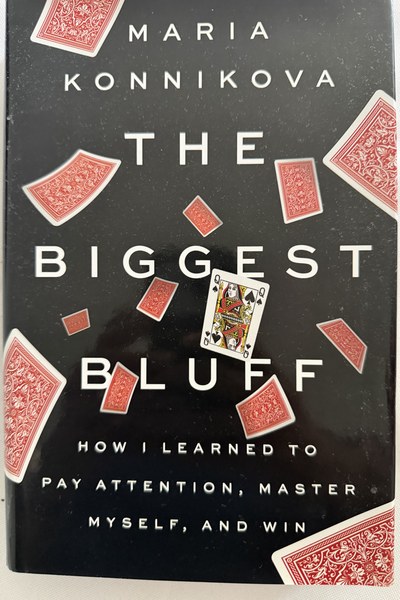
The Biggest Bluff, Maria Konnikova
The biggest benefit I can draw from the book is the example of Dragonfly, and been selective in bets. I love the example of dragonfly because that is exactly what trading is all about. Particularly swing and discretionary trading. Like a dragonfly I must anticipate the next move. I should be aware and well positioned to catch the next momentum, swing or reversal in price action. While, I remain happy with my current strategies, but this is another play I can add in my playbook. Yes, this will also be automated. But, my goal should be to become a dragonfly in trading from here on, and particularly in sports betting.
Another aspect is her idea of biases. She presents academic evidence of my theory that we make a decision about a subject within 3 seconds - she actually mentions that we do it in less than a second. Interesting, but its what she presents on this behaviour later on that’s important. Apparently, most people find it very difficult - not impossible and not everyone - to change our initial idea about a subject no matter how much new evidence to the contrary is presented to us. This is an observed fact by me, and I think the reason why people find me irritating and annoying as I present them new evidence. While they see it as me trying to change their view, I see it as my duty for them to reduce their bias.
To make it even more interesting she adds that mostly biased people attribute their losses to luck and start to complain about it. This complaining leads to a self-fulfilling prophecy whereby, eventually we develop a mental state of mind that lacks clarity in judgement. This lack of clarity turns an initial error in judgement into a series, which then becomes us nagging and blaming luck. However, if we can react unequivocally to both winning and losing, we could avoid falling into the trap of luck. Its more about sticking with a strategy, repeating it again and again, criticising and improving it. This is how one can overcome the emotions of trading and betting. My strategies are good, my execution is bad. I am chasing my losses in betting, which is what the authoress did at the start of her poker journey. She let the emotions get the better of her.
I did the same yesterday with Munich and Liverpool match. Titans was a good bet with a bad loss. Expectations were positive for the match, but dint turn out to be so. Tough luck, and I shouldn’t have reacted the way I did. I only ended up reacting that way because my risk was high on the bet and I want to win in both pots. We already know from the last year, focusing on both is never a good idea, and I shouldn’t do that. Learn from the past and do not repeat the same mistake. Either I can watch 5 matches and nail it, or keep digging a hole inch by inch everyday. Keep an open mind to this game of chance, and randomness and do not set goals with it especially in terms of time limits. Thats never going to lead to success.
As I improve I have to work on two things. Avoid exhaustive thinking, i.e. thinking with a tired mind or that’s how I remember it from the book. There should be enough evidence in my head and memory to highlight my losses when I have taken a bet with tiredness. Remember the last bet syndrome from the early days. I can now state that it was the consequence of exhaustive thinking. Additionally, exhaustive thinking in my experience is the first step into the tilt. I could sense I am about to go on a losing streak when my body reminds me to step off, but in the way past, I would risk even more chasing the losses. This year, I have reduced this aspect - not eliminated it -, to quite an extent but now I must eliminate it.
I can eliminate it by thinking on a long term horizon and take bets at a slower pace. It shall be fine, and I must overcome my mental bias and affection with the balance in the broker. Let’s focus on these till the start of this season. Additionally, I shall look at my mental energy and take time daly to reflect upon things and slow down. Take the afternoon walks now as the sunlight gets better, and stop been lazy in wearing clothes. Go for it, because this is going to be your downtime and your time to reflect. This also allows to become a dragonfly - wait, anticipate, kill. Above all’s lowing down and reflecting can bring OODA - Objective, Orient, Decide and Act - into practice also. Its been a while since I really reflected on my bets, and took time to mentally simulate the match in my head. I beehive its time to start making that a habit and do it again.
For me the best part of the book was Lodden’s thinking. Its a game which captures the human psychology and ego perfectly. Its a simple game of biased truth. While the players may or may not have to answer to a factual question, the correct answer is only known to Lodden. It can be as simple as asking how old was Gandhi when he died. While the correct answer maybe 80, it depends on what Lodden decided it was. The two competitors have to guess this number from Lodden, and the person closest to this guess is the winner.
This simple game illustrates what I call -‘Truths are a personal’ -, and collectively define culture, society, nations and progress. This is the real challenge that AI will pose to humans, because AI will work with a certain truth embedded in its algorithm. Simultaneously, humans will have to overcome their biases and accept the AI version or keep upgrading the AI estimate to become more reflective of the collective thinking of AI. This is where things will become interesting, and challenging. I believe we are 5-7 years from this event horizon. Meanwhile, life will go on as we live currently.