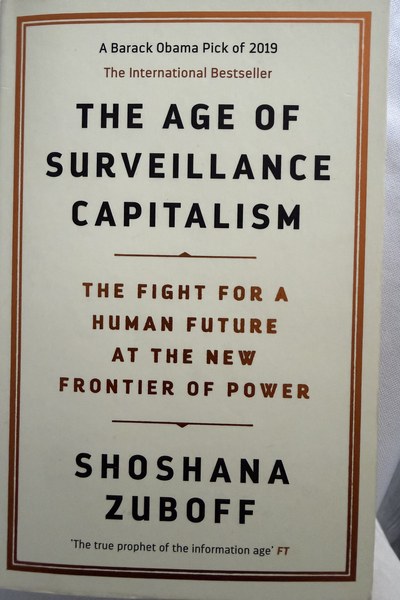
The Age of Surveillance Capitalism by Shoshana Zuboff
Maybe, its the book’s theme that pushes her to take an extreme view like this, but such a monotone overdrive is not worth it and is never going to convince people of her take. She will lose the ‘pathos’ aspect of humans in this. Even myself as an ardent fan of her view and cause couldn’t bring myself to finish the book because she repeatedly harped about it. She has written it with the attitude of a Dutchman - complain, complain and complain - without presenting a middle ground for solutions.
As an academic she continues to focus on her area of expertise without ever stepping into the shoes of her audience, who may have picked up this book for a light hearted reading on one of the most discussed topic of contemporary society. This remains a falling grace for most academics. In my view, this collective attitude of academics and reputed scientists is the cause of societal disharmony in contemporary times. Most academics - not all - are unwilling to concede in public or include information from a different perspective or opposite view into their own findings/research/conclusion.
I understand that academics are forced by external circumstances to behave in such a manner because 99.9999% of academic research is futile for society. So, they continue to push their ideas on society and administration in a speculative manner for the future benefit of society. However, it never does until some egoistical maniac and a narcissist entrepreneur starts to push old ideas and takes risk - actually allies with governments - to bring old ideas of Skinner et al. into fruition. The authoress details on how Google Streetview founder - Hanke - allied with CIA to push the whole idea of spying via satellites into Streetview, then spun off another company which used Pokemon Go to collect data so easily. Former NSA director McConnell has publicly said in 2010 that democracy doesn’t exist. If it doesn’t then what is US defending with their wars in the middle-east, Ukraine,e etc.? Their own oligarchs I believe.
A sidenote memory, in 2016 when my PhD colleagues were Gaga over Pokemon Go, I warned them that this is the aim of the game, but every one was willing to swap their free will and freedom for 10 euros worth of free coupons. This brings us back to the fundamental question of progress in society. In my estimation, roughly 20% of modern humans ever born may have died in battles in the last two millennia or since recorded western history for the defence of the free will. Are we honouring them and their sacrifice for a mere 20 euros free coupon worth of coffee. The authoress presents this core idea of ‘free will’ versus ‘Big Other’ knows best in a ‘I versus Them’ format. This is negative in my opinion, and with the amount of data at her disposal and research work that she presented in the book, I am sure she could have taken a better approach to connect to her reader and convince them. Maybe an evocative form of discussion to evoke sympathies with those who have died in defending the ‘Free Will’. In this she mentions these defenders merely 5 times in the entire book, while at the same time she has mentioned Skinner, Pentland, and other master of surveillance more than 100 times.
I understand that as a book surveillance capitalism, she must bring those people more times but she undertakes the risk of how human brain finds it difficult to evaluate criticalness from a numbers versus reason data. Her mention of Google engineer’s - Amit Patel -, to use recursive learning and meaning to every action is a prime example of this. She mentions how Google used spike in search of a TV character from 1970s’ Carol Broady in 2003 to push their idea.
Hofstadter [2] also mentions how the brain uses recursive learning to memorise and store experiences in a particular part of brain for easy recollection later on.Its similar to System 1 v System 2 thinking concept of Kahneman [3] where the brain quickly accepts easier decisions as default outcome from complex systems. By repeatedly harping monotonously about Surveillance, she has most likely put the reader in a negative state of mind in two formats.
Recursive learning is not the same as repetitive learning. Recursive learning seeks meanings from every outcomes while repetitive learning is doing the same thing again and again. The meaning associated or the conclusion derived by an individual from any incident is free thinking, and a consequence of his/her own past experiences. This is what Google and other Surveillance capitalists’ have stepped in to take away. They are applying the version of -‘Crowd knows best’ - albeit in a discreet manner where we are unaware about the actual data of the crowd’s individuals. The aggregation of data is necessary to present results but the maths must be open sourced. In this regard Twitter - now X - has deployed a better approach with their Community Notes, and how Elon Musk is willing to open source the codes.
The first one is obviously scary for freewill defenders find this dystopian outcome as a nightmare. Most of them will react to this with rage and ask - ‘how could they do this?’ To compound this, most free thinkers are unable to understand the other’s perspective - they defend their own free thought with stupid reasoning even with kins of their own -, and hence, unable to engage people in decorum to ask the difficult questions from the people responsible. Their most logical and popular response will be - ‘See, we told you the government is evil.’ This is out of their own self-interest to promote their own weapons’ owning philosophy on society. Any outcome from such behaviour only leads to more tyrannical form of governance for at least one generation.
The other negative state of mind is of despair where most people will simply get on with it. They find themselves helpless. This state of helplessness is not borne out of their lack of willingness to not do anything, but its more because they have no idea how to overcome this state of mind. With so much research work, and resources available to her, the authoress could have devoted atleast 10% of her book to present solutions to overcome these. Simple ideas could be use of VPN, masking IPs, etc. But, an academic’s vanity had to be presented in the book where she went on presenting her knowledge and bias towards it.
She could have evoked more empathy with readers by quoting Weizenbaum - inventor of the first chatbot ELIZA -, and his humanist views of Artificial Intelligence (AI), rather than harping on and on about surveillance. Weizenbaum’s quote on 291 can single-handedly bring more transparency about AI to people or make us more aware about what’s happening behind those closed source algorithms.
To her credit, the authoress does a great job in breaking down the entire process or technique of how this social surveillance begins. She does this in the first part of her book, when I found the book most appealing and interesting to read. This is mainly because she provided a structure to the entire process. Looking at that structure provides anyone an estimation of their own nodal position with respect to the matrix that is being built by the surveillance capitalists. I believe this is the biggest step where she could have bonded with her readers and provided more tools to come out of this matrix - if the readers wanted. However, she continued to present data to push her idea about how surveillance capitalism is bad.
My major disagreement with her arises from the fact that to push through a prevalent idea again in a book with so many resources at her disposal is a waste of resources at all front. Many -maybe not most - are becoming aware about surveillance and loss of our free will. Few of us because aware about it at the onset of it in 2013 - 6 years before the book was published - when we had spell checks popping up in our gmails. We have tried to find solutions since, and the best we could come up with VPN, and IP masking.
I feel had she taken a more constructive and engaging approach to take her readers on a journey to come out of this matrix or maybe make an improvement in their nodal positions, she would have done her job very well. But, she failed at it. I think this can also be due to her lack of genuine interest in solving the problem, being a Trojan horse herself for the surveillance capitalist or simply jumping on a funding opportunity to do her work. Or she is just a glory hunter jumping on the trend or maybe I expected more from her book after the first part or possibly, I am reading too much and need to slow down to gather an alternative views.
I believe the book is amazing for anyone interested in the subject of privacy but as person who works with algorithms and understands a bit more about algorithms, the the book dies out after the first 100 pages. It can be a good book for a proper societal discussion to start on surveillance and reining in companies like Google, Facebook, etc.. I believe like many other scholars on the subject and academics in general, she presented a very parochial view from her area of expertise. She could definitely have discussed an impact on the economic and political landscape of nations if they reined back surveillance. I believe this is the major lacking point in these discussions due to a tunnel vision of the academic/scholar.
One cannot and should not present a view of the future - irrespective of utopian or dystopian -without discussion the alternatives and status quo. Society must be presented with benchmarks before embarking upon a huge paradigm shift. I agree with her that the corporations used euphemism and other narratives to become so big at the cost of humans, but they presented their data - possibly by hiding the negatives - with benchmarks and an alternative. The alternative always evokes the feelings of ‘Grass is greener on the other side’ which makes people jump to alternatives without understanding the long term consequences of their actions. Maybe and a big maybe, when people start to see alternatives, they start to make free will choices. Most people choose status quo because they see no alternatives, but when they see or learn about alternatives, some do make the switch.
On page 489 she mentions how a new generation of activists are taking over by new radical ideas to bring back privacy and fight the big other. Signal jamming phone cases, facial recognition confusing masks, etc., are some techniqu