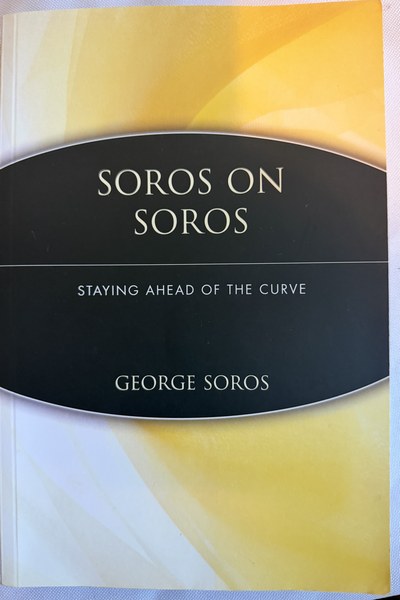
Soros on Soros
Great things are paradoxical and so is this book. I can judge this book in hindsight which allows me to be more critical of George Soros’ current mindset. But, at the time of this book’s publication, it is obvious Soros had a beautiful idea for the world. However, it feels in pursuit of his goals, he couldn’t contain his ego. The lack of constraint on this ego has made him look evil for the conspiracy theorists with his open society principles to govern the whole world. While, conspiracy theorists or his opposition uses this to criticise him for creating the New World Order - NWO -, however, I find this principles for Open society amazing.
I feel that in his determination to be deemed intellectual and accepted amongst the great philosophers, he was blinded by this ambition. In this blindness, he couldn’t clearly make the distinction where he had overstepped from his true vision of Open Minded Society to his megalomaniac approach of his vision and his righteousness on the world. This is the thin line he has crossed, and has failed to act upon his own guiding principles and foundations of Open Society.
It is also worth criticism that his actions lead me to believe that he is the biggest inside trader in the world who ain’t a politician. While he has leveraged the media very well to hide this dark and notorious side of his riding genius, I find it extremely impossible that he was not acting on the information that he would receive from the institutions he funded in the Eastern Bloc. Further evidence can be found in the form at how he conveniently left those countries when the markets began to mature - thus, making him ‘not so big a fish anymore’.
I do appreciate this candidness and honesty in these interviews where he is open to accept criticism, but tactfully avoids further delving into these critiques which could probably bring more insight into his trading style. Kind of suspicious I know, but still nice to read through. One should remain cynical about the timing of these interviews as these happen in the wake of his shorting pound, and is the beginning of his fame in trading. Looking at his career in the aftermath of these interviews, it is probable, that these interviews were carefully crafted with the objective of becoming a Big Fish in the forex trading in the Eastern Bloc.
His theory of Reflexivity has to be my favourite theory about the markets, and I hope something he should have pursued with more intellectual vigour to become intellectually renowned rather than force his open society approach on governments. Its interesting how he discusses the application of reflexivity on his own vision of Open society. Very few philosophers - I haven’t read many philosophers in my life - can critique themselves or their own ideas. This characteristic in itself is worth applauding and is evidence that he is a well thought out person who had good intentions for humankind at the publication of this book. However, on the other side of applying his reflexivity theory to open society, he does acknowledge that the ideal end of open society will lead to Orwellian society, or something like Brave New World. His mention of this approach suggests that he is himself opposed to the ideal end of Open society. This is why he encourages critique and discussion as the foundation of open society. Such actions will prevent open society from reaching such dystopian end. However, judging his current actions it seems he and his foundations are poles apart from the initial vision of his open society. Hopefully, I am wrong but
I am glad I read this book as it is profound and will have an impact on me in my way of living.