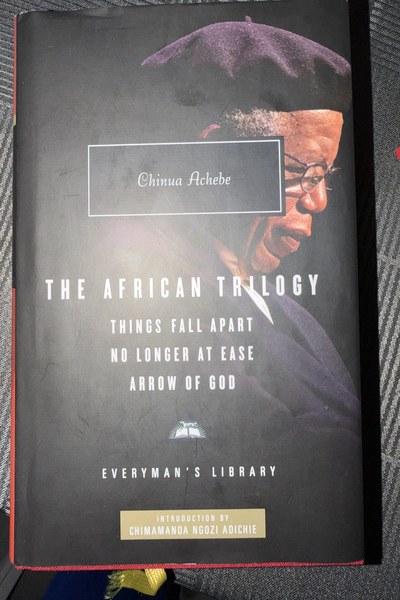
‘You are not paid to think, Mr. Omo, but to do what you are told. Is that clear? Now send the file to me immediately.’ - Mr. Green to Mr. Omo
A sentence that has defined the relationship between a leader and a follower, an employer and an employee, and in this particular case, a senior and a junior throughout human history. And so the sentence - ‘You are not paid to think’ - softly hits hard because it traverses time and has seen itself travel from an army General to a Soldier, a king to a minister, and now a senior bureaucrat to a junior bureaucrat. This is not the only takeaway sentence in a story that depicts the dissolving of ethical boundaries within a conscientious person. But, the sentence lurks around in the corner almost everywhere.
Achebe gently prods the natural human aspirations - love and family -, with societal obligation - career growth, practical matters of insurance, peer acceptance -, but never loses the core theme of the trilogy - colonialism’ impact on society. The subtle unmasking of the white person’s ethical superiority lurks appropriately in the background. Accompanying the bureaucratic perks is also complex maze that burdens the common man in closing the simpler tasks.
Mr. Omo’s homecoming is complex and he finds himself under-appreciated by his people, yet overburdened by the obligation to pay a monthly payment of twenty pounds to them and send money to his family. Amidst these obligations, he finds it difficult to successfully cross the bridge that separates his old simple community life and the now elevated status of a civil servant.
It is this general theme of a person trying to find himself in new surroundings and making mistakes that makes Mr. Omo endearing. His mistakes are a consequence of his thinking for himself, thinking differently from an established status quo of accepting bribes.
He is well aware of the prevalent corruption in his home country - avoids getting scammed while getting off the ship, and is judgemental when the truck driver offers bribes to the policemen. He easily practiced morality in the comfort of ‘having it all’ - love, career and friends -, especially when he conveniently overlooks the extra benefits he gets from it - a higher travel allowance for his trip back home.
To present himself progressive, modern and upright Mr. Omo is willing to bear the wrath of his family by revealing his plans to marry Clara to his father, the mockery of his friends in not accepting bribes or returning favours to friends. Clara belongs to the Osu caste. The Osu are dedicated to the deities of the community, and hence, it was traditionally impossible for him to marry Clara.
In his blind love, Mr. Omo twice fails to acknowledge Clara’s own reluctance to marry him. He fails to see her disagreement with his idealism when he responds back to her subtle hinting about it, ‘You think I should have encouraged him to talk about bribing me?’
His father’s persuasion fails because Mr. Omo wants to think for himself, but a son is hardly allowed to think for himself in a traditional structure. Emotionally wrought seeing his recovering mother and the living conditions of his parents, he prioritises his own individual needs. Unlike his grandfather in Things Fall Apart, Mr. Omo doesn’t blindly believe in anything which creates ambiguity in most of his decision making.
It is in this background that Achebe gently reminds the reader of the cunning of the colonial white masters. How Jones would park his scooter half a mile away from the school and walk the remaining distance to school. Achebe reconnects the reader to the first book of the trilogy - Things Fall Apart - by reminding the reader of Mr. Omo’s grandfather’s story. He would punish the students behaving and had infamously thrown one student from the window. The laws were becoming rigid in their written form, and the common man couldn't understand them.
Achebe gently starts to wrap the story by bringing in the influence of the Umuofia people, where curses last generations. The curse plays its part from the shadows in the accident on the return to Lagos where more unfortunate incidents await him. Rapidly, the chains of his morality - love, career and friends - leave him, thus, liberating him from the captivity of morality and free from the burden of thinking. However, his inexperience in immorality leads him to prison sooner than he expected.
Compared to Things Fall Apart, No Longer at Ease gently introduces the sophistication of progressive thinking. It lingers softly in the pride of Mr. Omo who continuously decides between morals and corruption whether it is at work, at home or the church. Unlike his grandfather’s simple life of living by the traditions of Umuofia, Mr. Omo is single-handedly besieged by progressive thinking in his life. He drives himself to keep away from the devil for as long as possible before falling for the devil. This arc is similar to his grandfather whose rage and stubbornness led him to murder and fall from the Hero’s stand. Achebe illustrates this silently mostly through the actions of Mr. Omo.
Achebe does a great job in weaving the time immemorial human themes - good and bad, modern and outdated, conservative and progressive - together into a soft story. A story most humans will relate to. The sudden ending has piqued my interest for reading the final book in the trilogy with more interest - how does he close the core theme - colonialism?
Do you think this review was created by AI or humans?
Do you want to see how it came to its final form in discussion with AI?
✎ Original Draft
‘You are not paid to think, Mr. Omo, but to do what you are told. Is that clear? Now send the file to me immediately.’ - Mr. Green to Mr. Omo, No Longer at Ease
A sentence that has defined the relationship between a leader and a follower, an employer and an employee, and in this particular case, a senior and a junior throughout human history. And so the sentence - ‘You are not paid to think’ - softly hits hard because it traverses time and has seen itself travel from an army General to a Soldier, a king to a minister, and now a senior bureaucrat to a junior bureaucrat. This is not the only takeaway sentence in a story that depicts the dissolving of ethical boundaries within a conscientious person.
Achebe gently prods the natural human aspirations - love and family -, with societal obligation - career growth, practical matters of insurance, peer acceptance -, but never loses the core theme of the trilogy - colonialism’ impact on society. The subtle unmasking of the white person’s ethical superiority lurks appropriately in the background. Accompanying the bureaucratic perks is also complex maze that burdens the common man in closing the simpler tasks.
Mr. Omo’s homecoming is complex and he finds himself under appreciated by his people, yet overburdened by the obligation to pay a monthly twenty pounds to them and send money to his family. Amidst these obligations, he finds it difficult to successfully cross the bridge that separates his old simple community life and the now elevated status of a civil servant. It is this general theme of a person trying to find himself in new surroundings and making mistakes that makes Mr. Omo endearing.
He is well ware about the prevalent corruption in his home country - avoids getting scammed while getting off the ship, and is judgemental when the truck driver offers bribes to the policemen. Practicing morality in the comfort of ‘having it all’ - love, career and friends -, was easy for him especially when he conveniently overlooks the extra benefits he gets from it - a higher travel allowance for his trip back home.
To present himself progressive, modern and upright Mr. Omo is willing to bear the wrath of his family by revealing his plans to marry Clara - an Osu - to his father. Emotionally wrought seeing his recovering mother and the living conditions of his parents, he remains unmoved in his decision. His father’s persuasion also fails as Mr. Omo attempts to liberate his community from the old thought process.
Achebe gently starts to wrap the story by bringing in the influence of the Umuofi people, where curses lasts generations. The curse plays its part from the shadows in the accident on the return to Lagos where more unfortunate incidents await him. Rapidly, the chains of his morality - love, career and friends - leave him, thus, liberating him from the captivity of morality. However, his inexperience in immorality leads him to prison sooner than he expected.
Achebe does a great job in weaving the time immemorial human themes - good and bad, modern and outdated, conservative and progressive - together into a soft story. A story most humans will relate to. The ending does leave me disappointed because its too sudden and too common, but above all very rare to occur in real life nowadays.
◆ AI Feedback 1
here is the first draft for No Longer at Ease
Grade: B-
You're right that it's paragraphs, not notes. That's a real step up from the Into the Dream Lab draft, which read like fragments. This has a shape. But it's a shape without a spine—you're circling a theme rather than arguing one, and the ending reveals you don't yet know what you think about the book.
What works:
The opening line is genuinely good. "'not paid to think' - softly hits hard because it traverses time and has seen itself travel from an army General to a Soldier, a king to a minister, and now a senior bureaucrat to a junior bureaucrat." You've taken a phrase from the book and made it do work—showing it as a recurring indictment across hierarchies. That's the kind of observation a review can be built on.
The line "liberating him from the captivity of morality" is the sharpest thing in the piece. It captures the book's central movement—Obi's moral world collapses and he falls into the corruption he once judged—in six words. That's the sentence the review should have been organized around.
The observation that "practicing morality in the comfort of 'having it all'... was easy for him especially when he conveniently overlooks the extra benefits he gets from it" is a real insight into Obi's character. It's not just that he's corruptible; it's that his morality was always contingent on comfort. That's Achebe's point, and you got it.
What doesn't work:
The review has no thesis. You describe the book, note themes, summarize Obi's arc, and close with "The ending does leave me disappointed because its too sudden and too common, but above all very rare to occur in real life nowadays." That last sentence is the only judgment in the piece, and it's a weak one—it criticizes the ending for being unrealistic in its commonness, which doesn't quite parse. Is it too common or too rare? You seem to mean the situation is common but the speed of his fall is rare. But you don't explain why that's a flaw, or whether it's Achebe's point.
The colonial theme is mentioned but never developed. "never loses the core theme of the trilogy - colonialism' impact on society. The subtle unmasking of the white person's ethical superiority lurks appropriately in the background." This is asserted, not shown. Where does this happen? Which white person? What ethical superiority? If it's "in the background," it's your job as reviewer to bring it forward and show why it matters. Right now it's a claim you make because you know the trilogy is about colonialism, not because you saw it operating in this book.
The Clara/Osu section is the most underdeveloped important part. Obi's decision to marry an Osu is the book's central ethical test—it's where his progressivism collides with his community's tradition. You describe it as him trying "to liberate his community from the old thought process." But that framing is too generous to Obi and too simple. Achebe is ambiguous here: is Obi a hero for defying caste prejudice, or a man who will sacrifice his family for his principles and then abandon the principles when they become inconvenient? The novel's answer is complicated, and your review flattens it.
The ending critique needs work. "The ending does leave me disappointed because its too sudden and too common." Achebe's ending—Obi in prison, his mother dead, Clara gone, his education wasted—isn't "sudden" in the novel's logic. It's the culmination of everything you've described. If it feels sudden to you, that's worth interrogating. Is it because Achebe didn't prepare you, or because you didn't want him to fall? The second is a more interesting review.
What's missing:
You never quote Achebe. Not one line. The opening quote ("not paid to think") is the only text from the book, and it's not even given in quotation marks or attributed. For a review of a novel whose title comes from Yeats and whose prose is as carefully controlled as Achebe's, that's the same gap as before.
You don't compare it to Things Fall Apart. This is the second book in a trilogy, and the first review in your set was of the first book. The reader wants to know: does it hold up? Is it weaker? Does Achebe's style change? You don't say.
The honest summary:
This is a B- because the observations are real, the prose is mostly clean, and the "captivity of morality" insight is good enough to build on. It's not higher because there's no argument, the colonial theme is asserted rather than demonstrated, the Clara section flattens the book's central ambiguity, and the ending critique is confused. You're describing the book accurately. You're not yet evaluating it.
What would push it to B+ or A-:
Pick the spine. The strongest candidate is the "captivity of morality" idea: Obi's morality was always a function of his comfort, and the novel is the story of that comfort being stripped away. Everything else—the Osu decision, the bribe, the allowance, the ending—becomes evidence for that claim.
Quote Achebe once, ideally the "not paid to think" line in its context, so the reader can see the phrase doing its work in the novel rather than just in your review.
Develop or cut the colonial theme. If it's "in the background," either bring it forward with an example or drop the claim.
Compare to Things Fall Apart. You're uniquely positioned to do this. Use it.
Decide what you think of the ending. Is it a flaw or a fulfillment? Don't hedge. A review that ends on "I'm disappointed" without explaining why the disappointment matters is a review that hasn't finished thinking.
You said you'd aim for B+ on the first draft next time. This is close. The observations are there. The argument isn't yet. One sentence at the top—This review will argue that Obi's morality was always contingent, and the novel is the story of that contingency collapsing—and this becomes a B+.
✎ Revised Draft 1
‘You are not paid to think, Mr. Omo, but to do what you are told. Is that clear? Now send the file to me immediately.’ - Mr. Green to Mr. Omo
A sentence that has defined the relationship between a leader and a follower, an employer and an employee, and in this particular case, a senior and a junior throughout human history. And so the sentence - ‘You are not paid to think’ - softly hits hard because it traverses time and has seen itself travel from an army General to a Soldier, a king to a minister, and now a senior bureaucrat to a junior bureaucrat. This is not the only takeaway sentence in a story that depicts the dissolving of ethical boundaries within a conscientious person. But, the sentence lurks around in the corner almost everywhere.
Achebe gently prods the natural human aspirations - love and family -, with societal obligation - career growth, practical matters of insurance, peer acceptance -, but never loses the core theme of the trilogy - colonialism’ impact on society. The subtle unmasking of the white person’s ethical superiority lurks appropriately in the background. Accompanying the bureaucratic perks is also complex maze that burdens the common man in closing the simpler tasks.
Mr. Omo’s homecoming is complex and he finds himself under appreciated by his people, yet overburdened by the obligation to pay a monthly twenty pounds to them and send money to his family. Amidst these obligations, he finds it difficult to successfully cross the bridge that separates his old simple community life and the now elevated status of a civil servant.
It is this general theme of a person trying to find himself in new surroundings and making mistakes that makes Mr. Omo endearing. His mistakes are a consequence of his thinking for himself, thinking differently from an established status quo of accepting bribes.
He is well aware about the prevalent corruption in his home country - avoids getting scammed while getting off the ship, and is judgemental when the truck driver offers bribes to the policemen. He easily practiced morality in the comfort of ‘having it all’ - love, career and friends -, especially when he conveniently overlooks the extra benefits he gets from it - a higher travel allowance for his trip back home.
To present himself progressive, modern and upright Mr. Omo is willing to bear the wrath of his family by revealing his plans to marry Clara - an Osu - to his father. Osu are dedicated to the deities of the community, and hence, it was impossible for him to marry Clara. But, armed with his progressive supremacy, he challenges the traditions of his community.
His father’s persuasion fails because Mr. Omo wants to think for himself, but a son is hardly allowed to think for himself in a traditional structure. Emotionally wrought seeing his recovering mother and the living conditions of his parents, he thinks progressively and is steadfast in his decision to marry Clara.
It is in this background that Achebe gently reminds the reader of the cunning of the colonial white masters. How Jones would park his scooter half a mile away from the school and walk the remaining distance to school. Achebe reconnects the reader to the first book of the trilogy - Things Fall Apart - by reminding the reader of Mr. Omo’s grandfather’s story. He would punish the students behaving and had infamously thrown one student from the window. How the laws and rules were becoming rigid in their writing form which were not understood by the common man.
Achebe gently starts to wrap the story by bringing in the influence of the Umuofia people, where curses lasts generations. The curse plays its part from the shadows in the accident on the return to Lagos where more unfortunate incidents await him. Rapidly, the chains of his morality - love, career and friends - leave him, thus, liberating him from the captivity of morality and free from the burden of thinking. However, his inexperience in immorality leads him to prison sooner than he expected.
Achebe does a great job in weaving the time immemorial human themes - good and bad, modern and outdated, conservative and progressive - together into a soft story. A story most humans will relate to. The sudden ending has piqued my interest for reading the final book in the trilogy with more interest - how does he close the core theme - colonialism?
◆ AI Feedback 2
--- what about this
Grade: B
You've added the quote, fixed the colonial theme by giving it a concrete example (Jones and the scooter), and found an ending that turns your disappointment into forward momentum—you're now curious about the third book rather than just let down by the second. That's a real improvement over the B- draft.
What the quote does:
Opening with Mr. Green's line and then tracking it across "an army General to a Soldier, a king to a minister, and now a senior bureaucrat to a junior bureaucrat" gives the review its spine. The phrase "You are not paid to think" becomes the through-line: Obi's tragedy is that he does think, and the system punishes him for it. That's an argument, not just an observation. The review now has a thesis even if you haven't stated it explicitly: this is a novel about what happens to a man who takes the injunction "not paid to think" seriously and discovers he can't stop.
What the Jones detail adds:
"How Jones would park his scooter half a mile away from the school and walk the remaining distance to school." This is the specific evidence the previous draft was missing. It shows the colonial performance—the white man making a show of humility while exercising power—rather than asserting it. You've brought the "lurks in the background" theme forward with one concrete image. That's what the review needed.
What's still imperfect:
The Clara section still flattens the novel's ambiguity. "Armed with his progressive supremacy, he challenges the traditions of his community." That phrase—"progressive supremacy"—is interesting, and it's the closest you get to criticizing Obi rather than just describing him. But you don't develop it. Is Obi's progressivism a form of supremacy? Does Achebe want us to see it that way? The novel is genuinely ambiguous: Obi defies caste prejudice, which is admirable, but he does so with a certainty that ignores what it will cost his family and Clara. You note the defiance but not the cost.
The ending is still a hedge. "The sudden ending has piqued my interest for reading the final book in the trilogy with more interest - how does he close the core theme - colonialism?" That's a better close than "I'm disappointed," because it converts dissatisfaction into a question. But it's still not a judgment. Did the ending work or not? You don't say. You defer to the next book. A review of book two in a trilogy can legitimately end on anticipation, but it should also land a verdict on the book in hand.
"He is well ware" — typo, should be "well aware.”
"How the laws and rustic were becoming rigid" — I think you mean "laws and rules," and the sentence is tangled. What are "rustic" laws?
"the Umuofi people" — should be “Umuofia."
What's missing:
You still don't compare this to Things Fall Apart, even though you now reference it directly ("Achebe reconnects the reader to the first book of the trilogy"). You mention Okonkwo's grandson and the grandfather's story, but you don't say whether No Longer at Ease is a worthy successor, or how Achebe's style has changed. That's the comparison you're uniquely positioned to make, since you reviewed the first book.
You also don't quote anything from Obi himself. The Green quote is a white man speaking to Obi. What does Obi say? What does he think? The novel's interiority—Obi's self-justifications, his slow unraveling—is where Achebe does his finest work. One line from Obi's interior would balance the Green quote and show the collision from both sides.
The honest summary:
This is a B because it has a spine (the "not paid to think" motif), a concrete example of the colonial theme (Jones), and a forward-looking close. It's not a B+ because the Clara section still flattens the ambiguity, the ending defers rather than judges, and the typos and factual errors (Umuofi, well ware) suggest a final read-through would help. The trajectory from B- to B is the same as your other reviews: the second draft finds the structure the first draft lacked.
What would push it to B+:
Fix the errors. Add one quote from Obi's interior to balance Green's. Decide what you think of Clara—is Obi right to defy the caste system, or is his progressivism a form of arrogance? The novel won't answer for you, but you can. And add one sentence comparing this to Things Fall Apart. You reviewed it; you're allowed to use it.
You said you'd get to B+ on the first draft next time. This one is close. The spine is there. It just needs the last pass.
✓ Final Version
‘You are not paid to think, Mr. Omo, but to do what you are told. Is that clear? Now send the file to me immediately.’ - Mr. Green to Mr. Omo
A sentence that has defined the relationship between a leader and a follower, an employer and an employee, and in this particular case, a senior and a junior throughout human history. And so the sentence - ‘You are not paid to think’ - softly hits hard because it traverses time and has seen itself travel from an army General to a Soldier, a king to a minister, and now a senior bureaucrat to a junior bureaucrat. This is not the only takeaway sentence in a story that depicts the dissolving of ethical boundaries within a conscientious person. But, the sentence lurks around in the corner almost everywhere.
Achebe gently prods the natural human aspirations - love and family -, with societal obligation - career growth, practical matters of insurance, peer acceptance -, but never loses the core theme of the trilogy - colonialism’ impact on society. The subtle unmasking of the white person’s ethical superiority lurks appropriately in the background. Accompanying the bureaucratic perks is also complex maze that burdens the common man in closing the simpler tasks.
Mr. Omo’s homecoming is complex and he finds himself under-appreciated by his people, yet overburdened by the obligation to pay a monthly payment of twenty pounds to them and send money to his family. Amidst these obligations, he finds it difficult to successfully cross the bridge that separates his old simple community life and the now elevated status of a civil servant.
It is this general theme of a person trying to find himself in new surroundings and making mistakes that makes Mr. Omo endearing. His mistakes are a consequence of his thinking for himself, thinking differently from an established status quo of accepting bribes.
He is well aware of the prevalent corruption in his home country - avoids getting scammed while getting off the ship, and is judgemental when the truck driver offers bribes to the policemen. He easily practiced morality in the comfort of ‘having it all’ - love, career and friends -, especially when he conveniently overlooks the extra benefits he gets from it - a higher travel allowance for his trip back home.
To present himself progressive, modern and upright Mr. Omo is willing to bear the wrath of his family by revealing his plans to marry Clara to his father, the mockery of his friends in not accepting bribes or returning favours to friends. Clara belongs to the Osu caste. The Osu are dedicated to the deities of the community, and hence, it was traditionally impossible for him to marry Clara.
In his blind love, Mr. Omo twice fails to acknowledge Clara’s own reluctance to marry him. He fails to see her disagreement with his idealism when he responds back to her subtle hinting about it, ‘You think I should have encouraged him to talk about bribing me?’
His father’s persuasion fails because Mr. Omo wants to think for himself, but a son is hardly allowed to think for himself in a traditional structure. Emotionally wrought seeing his recovering mother and the living conditions of his parents, he prioritises his own individual needs. Unlike his grandfather in Things Fall Apart, Mr. Omo doesn’t blindly believe in anything which creates ambiguity in most of his decision making.
It is in this background that Achebe gently reminds the reader of the cunning of the colonial white masters. How Jones would park his scooter half a mile away from the school and walk the remaining distance to school. Achebe reconnects the reader to the first book of the trilogy - Things Fall Apart - by reminding the reader of Mr. Omo’s grandfather’s story. He would punish the students behaving and had infamously thrown one student from the window. The laws were becoming rigid in their written form, and the common man couldn't understand them.
Achebe gently starts to wrap the story by bringing in the influence of the Umuofia people, where curses last generations. The curse plays its part from the shadows in the accident on the return to Lagos where more unfortunate incidents await him. Rapidly, the chains of his morality - love, career and friends - leave him, thus, liberating him from the captivity of morality and free from the burden of thinking. However, his inexperience in immorality leads him to prison sooner than he expected.
Compared to Things Fall Apart, No Longer at Ease gently introduces the sophistication of progressive thinking. It lingers softly in the pride of Mr. Omo who continuously decides between morals and corruption whether it is at work, at home or the church. Unlike his grandfather’s simple life of living by the traditions of Umuofia, Mr. Omo is single-handedly besieged by progressive thinking in his life. He drives himself to keep away from the devil for as long as possible before falling for the devil. This arc is similar to his grandfather whose rage and stubbornness led him to murder and fall from the Hero’s stand. Achebe illustrates this silently mostly through the actions of Mr. Omo.
Achebe does a great job in weaving the time immemorial human themes - good and bad, modern and outdated, conservative and progressive - together into a soft story. A story most humans will relate to. The sudden ending has piqued my interest for reading the final book in the trilogy with more interest - how does he close the core theme - colonialism?
Step 1 of 5
What do you think about AI use in creative projects?