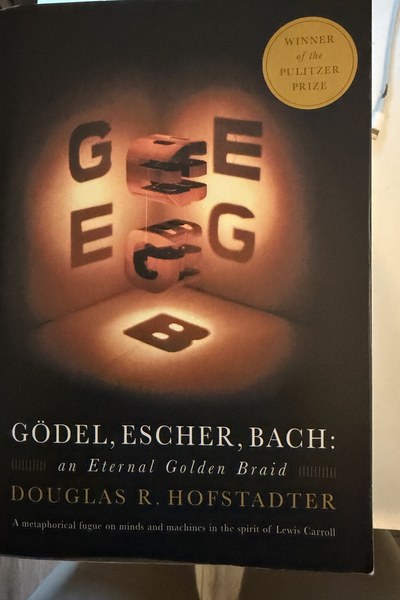
Godel, Escher and Bach, Douglas E. Hofstadter
Most books on AI and data, in order to sound sophisticated and advanced, only discuss math, current topics and eye grabbing trend setting, but GEB begins with an attempt to define or discuss ‘What is intelligence?’ This is an important and most overlooked issue in AI today. Most companies, news and funding is currently imitating the trendy catch words, and not actually addressing Intelligence. While I may not agree to his definition of intelligence verbatim, because he also suggests taking advantage of situations for personal benefits as intelligence - I call that exploitation -, but I do agree with other aspects of his definition of intelligence.
The author also attempts to address the query of creativity and ownership rights in the world that will be dominated by AI. Who is the creator - the software writer or the original composer in the case of music production via LISP or other form of software? He presents a good argument where one software writer combined two different songs using LISP, and he rightfully allocated ownership rights to the software writer while the AI community thinks it is the software which is the creator.
I agree with the author’s version, because the idea - the basic tenet of intelligence in this incident - is the fusion/mixing of the two songs. The remaining part where the software fuses the two songs is simply repetition of intelligence. To elaborate on this, my understanding of Pythagoras’ theorem and using it in high school mathematics’ exam does not make me the creator/founder of Pythagoras’ theorem. The above incident is similar to that, and in that very aspect it is the state of AI today. We are basically creating automation of tasks and calling those intelligence, in other words, we are plagiarising analogue ideas into digital world without giving due credit to the original founders of those equations/fundamentals.
Another important aspect that he brings to light is how bias works and may work in the future. With the Sagredo, Simplicio, Salvetti2 story from the medieval age to discuss the merits of the Copernican system, he explains the reinforcement learning aspect. However, he is quick to highlight that more reinforcement does not bring the truth to surface, it only serves to exaggerate our bias. The original story in 2 is created by Galileo to support the Copernicus system over Ptolemic system. He did this in a metaphorical way to avoid the wrath of the Inquisition, while Hoefstadter uses it to show how repeating the same argument of Sagredo without any new facts/content by Simplicio leads him to believe Sagredo which may be farther than the truth of Salvetti.
It is a mere coincidence that I keep coming/reading content which reinforces my belief that Nature has no obligation to explain itself to us3. Our concerns, stress and anxiety with nature comes from our desire to control it and be its masters. The author explains this in a better manner by suggesting that its us who are trying to codify nature and its laws to derive classical meaning from things that are fleeting and probabilistic. We conveniently add constants to fix the nature’s working to our understand, and when there is deviation from the constant, we increase its order or find more parameters to keep it fixed to within a margin of tolerance. Did nature or its working change or did we simply add matter to it for convenience of not accepting that ‘We may be wrong and have yet to understand it better?’
If the ability to adapt things to our own convenience is intelligence, then we do not need and should not pursue AI research anymore, because AI will take away our flexibility to exploit incidents to our own benefit. Herein lies the biggest challenge that society needs to overcome in order to embrace AI. While, overcoming this thought/mentality will lead to a fairer world, but it will take away our egos - the very thought that makes us feel more important than we ought to.
With the idea of Strange loop - Hofstadter tries to imprint the meaning of it in Escher’s paintings but I fail to see it even though he wants me to see it. Accepting to see this in the paintings - Waterfall, ‘Ascending and Descending’ -, is simply conforming to the description and the author’s bias. This is a convenient trick to implant your own version to other person’s thought process.The idiom is - ‘planting a seed in other people’s heads’.
On page 26, Hofstadter defines or lays down his definition of intelligence, which are mostly agreeable to me except for the second point to me. In the second point, he suggests intelligence as taking advantage of an opportunity, where do morals stand in he hierarchy of such standings?
In chapter 5 he explains that contradictions are a part of Zen world and the probable reason for their peace because they accept it. Why is Euclid’s loose statements taken as theorems of geometry, but the same laxity is not extended t interpretations of ancient texts from the east? Is this bias intentional or unintentional?
In my understanding of current AI development, ‘addition of new rules/data to bring completeness to a system leads to more incompleteness of the system, and thus, in an infinite loop'. The additional data added to AI is intriguing because in order to limit randomness we some how end up with more randomness. In other words, the current challenge that AI faces is the problem of Reductionism. Its more important to decodify little data with more meaning rather than add more data to add more meaning.
If we continue on this path of adding more data, we will eventually reach at the level of quantum mechanics. At that stage, the challenge we will face is less of AI but more of quantum physics. It will all begin with addressing Heisenberg’s uncertainty principle where we might not know are we observing the data or influencing the data. This is already evident at the higher order of system in the form of self-fulfilling behaviour by citizens in respond to big data governance. Although its good for societal behaviour but it does lead to dystopian future as suggested by George Soros himself4.
In chapter 6 and 7 he mentions Aleotrical information. He further defines epigenesis as the information retrieval of phenotype from genotype under appropriate conditions. He presents haiku conversation of T and Achilles where each person is free to derive his own interpretation from it. However, this does bring me to a very important theme I discuss with friends - what is ‘anything’? Isn’t communication, intelligent all about the doer and the seeker’s response to information.
In his chapter of Zen - chapter 9 - associated things, I come to the understanding that the world’s dilemmas arise because we seek meaning of everything. I have long discussed this aspect with my friends about how the world is more random - and it continues to grow more random -, than we can possibly imagine. But, in order to label things and derive meanings from non-meaningful aspects, we seek meanings from events and occurrences whose correctness is determined not by truth or fact, but by popularity, money and lobbying. While, its obvious and like I have said in the past, that only the actor knows the absolute truth of his actions, rest of the world is merely interpreting, this becomes obvious by how zealots of Zen try to invoke meanings to anything said by a master.
This is analogous to the anecdote by a writer who was interviewed and asked - ‘How sad the character is that he even sees the door as blue?’ To this, the writer responded, ‘No the character wasn’t sad if you read the book properly, but the door is blue because I wanted a blue door.’ However, the interviewer insisted ‘No the character was sad, and this subconsciously the writer made it a blue door.’
These interactions happen daily, and the best we can do is to take the man by his word, and not invoke meaning to actions with or without context. In a just and fair society, every man’s word should and will have the same weight irrespective of his rank, wealth and status.
In Chapter 10, he brilliantly captures the cause of boredom from repetition. Something about the thrills of unknown getting replaced by the boredom of repetition. The thrills can be recaptured again by using a surrogate like a rookie’s ears or etc., or more importantly by improving the details after finding flaws in them. This is where my struggles are at the moment. My inability to find errors in my algorithms to improve them. Maybe, I will need to step back and look again as to how can I improve it. Benchmark it with introduction of new parameters one at a time? I will need to do this to diversify risk and bring it to a minimum at all times.
Chapter 11 - Holism versus reductionism. Interesting chapter and the one which actually defines the boundaries of challenges that AI must overcome. Which is a better way? Can statistics alone determine if the neuron will trigger or not? Based on that, isn’t AI going to influence us in the future and ones controlling the statical algorithm for it determine what to see and what to not see? Local memory versus globalised memory in the brain? Has social media discovered this and exploiting the localisation of memory in brains to incite negative behaviours from people?
Chapter 12 - Symbol and isomorphism. This chapter describes the application of Shakespeares’ quote - ‘What’s in a name? A rose would smell as sweet as it does were it called by a different name’ - most aptly.
Long have I wondered myself the futility of naming it all, when the description of an object or a phenomena is more important and relevant. Symbols in the brain are used to describe, and its only the different conjuring by people which differentiates the description. While some beautify them, others nullify them but very few rationalise them, i.e., ‘Call a spade a spade’. The brevity or the beginning of describing objects with terms possibly may have diluted science, truth and humanity to its core. Descriptions allow more precision because the words differ little in their meanings, but a single term can lead to many interpretations. The term is a single root which can evoke many nodes and signals in different directions unless the correct reference for its use is specified - such as law book so and so. However, a description will have multiple nodes and signals but each of these nodes - the objects of inquiry - will be limited in their extended meaning. Thus, the beginning of the usage of the brevity and terms may have been promoted to limit knowledge to an elite group and build a scholarly feeling about themselves with it.
Its a very very good book. I did enjoy it and is a book I will definitely come back to read again. I feel I rushed it in the second half as it did get tedious and more academic. This is where I will need to read it again.
Initially, the writing style of alteration between the dialogue and then its AI equivalent was nice because it was different. In the second half it was boring, I guess due to the repetitive style. Additionally, in the beginning I got new information from those seemingly nonsensical dialogues, but later on it all sounded gibberish even though it was heavier in content. But, I guess at this time, my focus in the book was deteriorating as it delved deeper on a technical level.