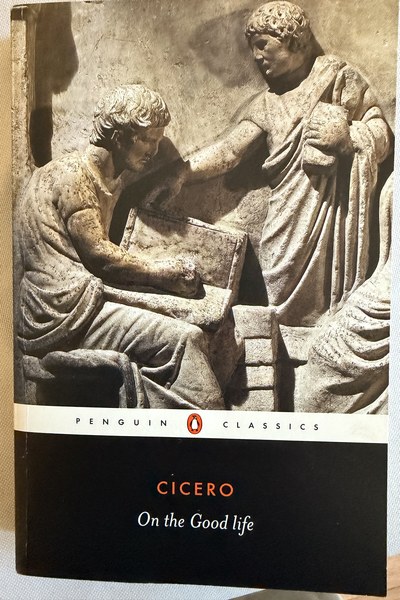
On the Good Life, Cicero
Cicero leaves behind a good deal of knowledge from his time. He discusses the morality of his peers, and also his aspirations of a fair and just society. While his notes are written mostly in his time of exile from Rome - he is discussing in Tusculum -, and I feel it has a sense of more than justified antipathy towards Caesar, but it still remains a trove of knowledge and morality for us mere mortals.
The factor that glued me to his book was his mention of re-incarnation which he claims was first mentioned by Pythagoras. In further pursuit of this fact, I did check on wikipedia that Gita is indeed five centuries after Pythagoras while Mahabharata - where Gita is intertwined -, is written over a period of four centuries - 8th - 4th century, BC. One of these is the time of Pythagoras - 5th century BC. This coincidence does bring me back to my hypothesis that cultures were more intertwined and global for the then known world than today.
Another fact to substantiate this is his mention of seven wise men. How they had sowed the seeds of Roman and Persian culture. How they did re-facilitate the growth of life and civic society after getting flooded. Isn’t this just too much of a coincidence? It baffles me to find this truth, and more importantly for the world to learn this and accept each other in a better way than we do now.
An additional fact is his mention of the act of Sati in India. However, he provides an additional detail in it. Not all wives committed the act of Sati in his times, but it was the favorite wife. The wives would fight amongst themselves to decide who was his favourite, and it was she who would perform the act of Sati. This is similar to the Viking culture where the master’s favourite mistress was drugged and set on the burning boat to Valhalla with the master’s dead body. The doubt about similarity and coherent amongst cultures in the past continues to erode in my understanding with my continued discovery of new facts through books.
While we claim to have understood the growth of cities and civilisation, Cicero in a very direct - maybe not substantiated - manner mentions that cities and city states grew out of a desire to live in harmony and peace. It was the natural growth of settlements that had a common culture and belief. Such places did not require taxes, particularly property taxes, to be paid. However, emperors, rulers and tyrants were only supposed to levy property taxes in the event of funding their wars overseas. Simultaneously, he appears to be a peace loving person and is against these wars.
He adores and thinks of the Roman culture as the zenith of human civilisations and expects his fellow Romans to extend great hospitality to their guests in order to highlight the prime of Roman society. This intrigues me because currently, Europe is doing this to refugees and immigrants but in a positively extreme way, and with the cost of disintegrating their own culture. Cicero promoted hospitality but not at the cost of the decline of the Roman cultural values, which is the price Europe is willing to pay at this point in time.
Looking at his description of the then solar system or universe as he calls it, it baffles me about how stupid and simultaneously smart they were. They did know the sequence of planets very well, but had interchanged the Sun and Earth to fit their own bias of Earth been the centre of the universe. Had they not done it, maybe we could have made better progress in astronomy and space sciences by now. Maybe. Nevertheless, what has to be will be.
I like his views on property taxes in particular. It addresses two concerns for me. While the Americans scream at they top of their voices, that income taxes are only an invention of the 20th century, his book makes it clear that taxes were levied even back then, but property taxes were only levied in times of wars. He does not provide an explicit mention of income taxes, and that is only my deduction from his discussion on property taxes. So, contrary to urban myth of cyberpunks that taxes did not exist, I think they have existed for ever since.
Secondly, its evident that he understood the necessity of taxes, and expected return of safety, medical care, etc. from his government. This is critical because this does mention that medical care has been present in atleast the western society since 2000 years ago. What we in modern or post-modern times have to address is taking on the responsibility of proper administration of our taxes. While, it may not have been possible in the era of Cicero, it is easily doable in todays society with the help of digital tools and transparency.
Btw, modern medicine claims to be improving the longevity of human life, but in his book, Cicero mentions a couple of people who lived till the age of 80s. Its interesting because while the average mortality maybe low in those times due to wars, and bandits, etc., but a healthy lifestyle provided an age as long as we live now with a healthy lifestyle. This does provide ammunition for debunking the biased truth of the impact of modern medicine on human life.
While, it is true that modern medicine has improved our diagnosis of disease but its an incorrect measure to evaluate its impact on the natural longevity of human life. To assess the natural longevity of human life, we have to identify the age of people dying of old age - I am aware that its quite complicated -, in the past with the old age now. The rural myths of people living to age 100, etc. in modern rural life may have more legs and reason to it, then we believe or want to believe.
Interestingly, they also had medical care in those times. Wow, isn’t that bewildering, and he specifically mentions that collected taxes should pay for them. This is the beginnings of modern society and a good one at that. While today, we are egoist to call our selves as a society with universal health care, the truth is in North Europe, there is no universal health care. It is similar to other countries, where you pay from your own pocket for healthcare. However, while in other countries you have to choice to opt out and bear the risk in times of medical illness, in North Europe it is mandatory to pay this. No wonder, they want the NHS, Spanish and Italian health care to get privatised soon.
One attribute that does associate and make us closer and similar to the Romans of back then is how Cicero reveres the philosophers of his past. He has great admiration for Socrates, et al., and the other Greeks even though he is slightly condescending towards his contemporary Greek civilisation. This embrace and respect of cultures which he does not hold in high regard during his lifetime, has a lot to teach our society. We should be able to bring forward the goodness of the past of various cultures, and move forward collectively as a human species with a refined view of all things in the past, and greater learnings. This could enable us to put aside our differences and move forward at a better pace. However this will raise the conflict of globalists’ versus local agenda?
The most important aspect that I read from his book was the aspect of how bad debt was paid by the government in exchange of favours for the future. How dissidents were banished from their property and exiled, while their property was allocated to sycophants. This does remind me of our own modern times, where sycophancy and great orators gets rewarded. While Cicero promotes good oration, and holds oratory skills in high esteem, he does also caution his audience about finding the knowledge and truth in those orations. He believes a lack of knowledge with good oratory skills will be found out eventually, but a good knowledge without good oratory skills is useless and not beneficial for society.
He presents numerous examples of great oration like ‘The Dream of Scipio’ where Scipio is able to convince his audience to stage a coup to his loyalist friends who were loyal to Rome. I think Cicero uses this to highlight the power of oratory skills as how great oratory skills can convince the most diehards to even change their mind. Isn’t this what today’s media does? This also brings me back to the greek concept of ethos, logos, pathos, in preparing a speech. There is definitely benefit and use of it, but the truth is incomplete in it, and hence, not my cup of tea. Maybe, writing with a good ability to arouse the sensation of the reader will suit me better. This endeavour I must endure for the duration of my longevity.
In his friendship commentary, I admire how he clearly states that loyalties towards friends should change when the friend changes. If a friend you knew as good as become rogue, then this friend must be abandoned with haste for he can lead you in a journey of regrets in the future. Your prime loyalty is towards the nation state is what Cicero believes. Apart from the religious state loyalty, the concept of abandoning friendship is similar to the concept mentioned in Quran and Gita. Did moral codes of society get bind in a book and get renamed as religion?
Cicero’s idea on friendship are similar to krishna-sudama’s friendship where a friend who criticises is more important and to be cherished rather than the one who demands loyalty and cannot hear a backlash. This is a difficult execution for it does cost friendships and thus, a loss.
Have I found more joy in anything else other than discovering these esoteric facts? The only reason for this joy is my logistical growth of developing an unfound ability to stand with - not amongst - these intellectual giants of the past. But, then like Cicero and the other greats of the past have said, ‘There is nothing more moral and nobler than the pursuit of high morality and knowledge?’ And I agree.