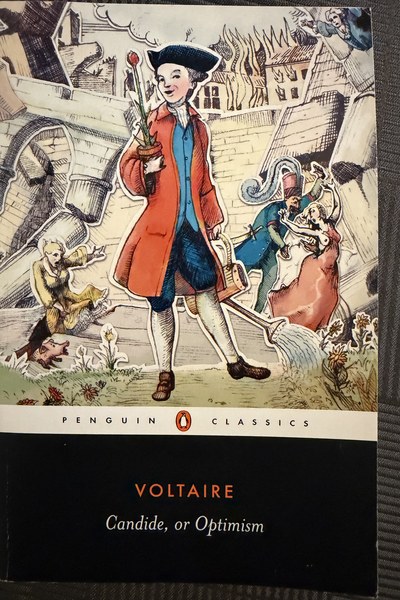
Candide, or Optimism by Voltaire
Firstly, isn’t this strange that Optimism - the word -, is used for the first time in literature in this book. That should be sufficient reason to read the book. However, in a positive scary manner, I always associated Voltaire as the person responsible to bring optimism into society. Even though this is the first work I have ever read by him. This is so canny but at the same time extremely plausible that I read this esoteric fact somewhere in some book. I would most likely say, it was in ‘Citizens’ by Simon Schama.
Nevertheless, the book is focussed on a lot of philosophical and political aspects of life. The protagonist - Candide - is in the eternal quest of the most miserable person in his travels, and continuously befriends them when he deems one to be the most miserable person he has found. His reason for this is to counter his Professor Pangloss’s thought that everything turns out to be fine and good in the end. Isn’t this eerily accurate about life too? Similar to Candied accepting his baron’s daughter as his wife after she has lost her beauty and been happy about it, do we all not just accept our fate even though we may have started our pursuit with an expectation of different outcomes. Isn’t this compromise we all make when we do not get our childhood dream career, etc.? Isn’t this compromise also the source of happiness and joy at the end, which prevents us from been miserable.
Another reason to appreciate this book is how the old man in Turkey towards the end of the book reveals his secret of happiness - ‘I stay out of politics and thus, I am happy. All politics and power games have the same end.’ To further his wisdom on life, when asked why does he work if he is happy, he responds -‘I work to avoid the three evils - Boredom, Vice and Necessities’.
In this one simple and harmless sentence, the old man in the book actually sows the seeds of the Nazi propaganda ‘Arbeit macht frei’ which is another way of saying that we shall all work so that we cannot think of other things. Maybe, I am overstretching my imagination to make the connection, but the old man’s sentence at the end of this book in 1780s is a revelation for me.
Additional insight from the book is how politics all over the world - except for El Dorado - was full of hatred, vengeance, murder, rape, and war crimes which neglected the international law. This is a truer representation of politics in the most universal manner and I find this a better read than 1984 3 by George Orwell.
Although politics is not the central theme of Candide, but it does highlight the pain, torture, misery and uselessness of politics. In comparison to 1984 3, I found this to address the same issue about the heartlessness and controlling nature of the powers that be. But, while Orwell presents the man hopeless in his quest to overcome the challenges of the politics, Candide, presents a hope in overcoming this.
The philosopher Martin in the book provides hope and explanation for the misery in the world, while Pangloss’s view that everything works out for good in the end is a positive sign for all the misery that one endures in his life. It is only the protagonist’s pursuit of newer experiences, that makes his previous misery go away or feel reduced pain. While Orwell presents this in a controlled dystopian manner, Voltaire presents this in a more optimist manner due to the freedom prevalent in society.
The setting and the richness of the book is the direct consequence of Voltaire’s belief that history does not need to be fluid in time. Come to think of it, if history wasn’t fluid in time, we would be unable to bench mark our pains, and forever be happy by living in the present. Ok, I am losing my chain of thoughts but I believe I will be able to add more to this review or my life as I grow in experience.
On the writing style, the book is loquacious, which maybe the style of writing in those times. It will be a reflection of the huge amount of time that people had in those days, with little to do outside of the necessities of life.
Nevertheless, its a great book and a mandatory read for everyone in the world. Gives, hope, openness and freedom of thought to everyone.