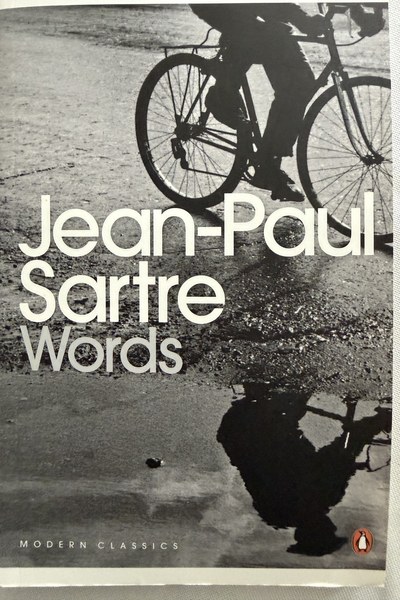
Words by Sartre
The origins of poor literature and trash writing lie in a person’s desire to write long sentences to exude sophistication. The academic rigour and necessity of coherence creates lines of unnecessary words, ideas and thoughts. This has created a poverty in post-modern literature where the simple, short genius of Sartre and Camus storytelling has long been forgotten.
Sartre’s ‘Words’ is probably about his childhood, and definitely my favourite of his books I have read so far. It’s 152 pages long, has a good detailed description of his relationship with people that a kid grows up with - mother, grandfather, friends, teachers. It was a page turner but has nothing coherent, it was fast paced but filled with colons, and semi-colons, to evoke transient thoughts like a child. It created an urgency without a direction.
First published in 1964 - when Sartre was 69 -, it still captures the childishness of an individual. He jumps in his thoughts and never develops them like a child. He is writing from memory, but is short of time like every kid in the world who is distracted with other most important things.
His discussion on literature and its importance is subtly displayed. From the imagination of a kid reading fairytales to the precision required in creating real characters are worth weight in gold. His idea on dying and art overlaps with Kundera’s idea of immortality. I prefer the latter’s version - ‘to become immortal, one must die. But the truth is no one wants to die yet become immortal.’
Like great literature it was a dichotomy. While the book portrays his adulation for his grandfather, he ends it with saying others felt that his childhood was harsh. Or maybe I did not get it. He was humbly arrogant about his prodigy but it comes out so sweet with a childlike innocence.
He also most likely camouflaged his arrogance through the lady’s prediction about him, and his dreams of the cemetery he wanted to be buried in. Now on more reflection, I feel an experienced reader would see his arrogance cut through that humility. The courage to criticise Cervantes but to do it towards the end of his literary career shows his controlled arrogance.