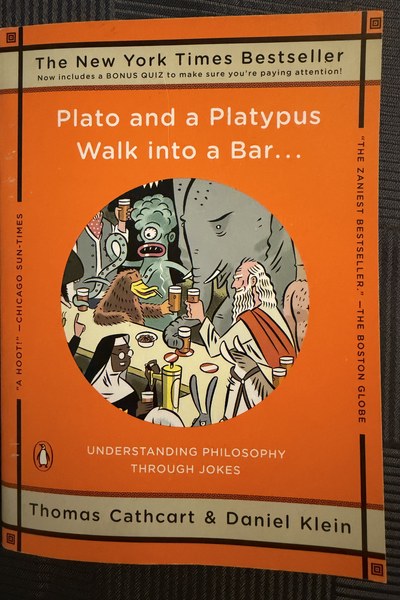
Plato and platypus walk into a bar
While the name seems funny, and the authors do make a big attempt in presenting the dour subject of philosophy in a humorous manner, the book can best be categorised as a comprehensive overview of various western philosophy. Anyone who wants to be called a philosopher could read this book and understand or categorise his own philosophical practice.
It lacks depth in any topic which should not surprise the reader given the book’s name. The reader must decide for himself what he seeks from this book. I am not a philosophy student - just a keen enthusiast -, but this book does come across as a good introduction to various kinds of western philosophy. I was able to finally understand the fancy words used my peers but I also used induction to deduce that they were.
Funny enough, in its chronology of evolution of philosophy it mentions Buddhism as the first philosophy, but barely discusses it - just mentions it in passing. Confucianism and Taoism are completely overlooked along with the Ancient Greeks barring Plato and Aristotle - Yes, Socratic philosophy is not mentioned even in passing, but mentioned in relation to Plato’s view of Socratic dialogue.
While it identifies and discusses the western philosophies mostly, it doesn’t dig deep into the eastern philosophies - it mentions them in passing. Its structure of listing or briefly discussing the western philosophies did provide the authors with enough room and flexibility to add eastern philosophies in it too. Probably, I feel relatively left out from being understood in the west.
Personally, I related to the book quite well in terms various philosophies - , particularly existentialism and relativism - and why I can be so uninteresting to others yet inspiring. I found it exasperating that they do not go deep into relativism and is only briefly mentioned at the end. Relativism must have been one of the oldest thought process in human psychology, if not the oldest.
The primates were cohabiting the planet with nature alongside them, and the night sky above them along with the sun and moon. It was probably their relationship with these objects of the universe that led to first thoughts of humans of ‘who we are’ and ‘meta’ (beyond the abstract) world.
The age old philosophical queries - where do we come from? What lies beyond the night skies? - probably lead to first disagreements amongst the primitive societies. Consequently, they may have had skirmishes from the various interpretations and relationship they developed towards nature. The shamans and the mediums used in primate and tribal societies to overcome diseases and natural disasters is the seed of relativism.
Religion, existentialism , inductive method, etc. are most likely derivatives and consequence of relativism as humans evolved from individualism to social groups. Relativism is probably the root cause of other thoughts to develop indirectly, and essential for survival. It is human’s curiosity about their being and after that leads to initial worshipping of nature followed by paganism, and theist religion.
Two primates would have different idea of what the sky above is, and would have worshipped them differently. Their disagreements probably led to wars, clans and group thinking. The group thinking probably led to religion or culture which divides us as society today but keeps us in relatively harmony with different ideas compared to the past.
Would pagan sacrifices of their own flesh mean anything without relation to natural disasters? Would Abraham have sacrificed his son if he could not have related it to God? Would Jesus have allowed himself to be sacrificed if he hadn’t evaluated his own actions compared to his contemporaries?
These actions were mostly done in an egoist relativism to be in power barring Jesus. Jesus sacrifice only became a sacrifice after St. Paul made him a martyr for humans two hundred years after his execution. While Abraham used his sacrifice to rule his society.
Even Machiavellian thought arises from relativism. It is the disrespect or condescension towards the opponent’s view that makes the victor exploit the otherwise balanced ethical situation. Similarly, atheism is in relation to theist philosophy. An atheist wouldn’t exist without a theist. But similar thought cannot be extended to agnostics who would exist due to their indifferent attitudes towards both philosophy.
The jokes we hear in normal days seem to have originated from philosophy at different times in human evolution. If not, then philosophers have missed out on a lot of fun and easy marketing. Some of the jokes shared by the authors are quite commonplace, and are heard in common social circles. The lack of Ancient Greek philosophy in particular epicurean and Pythagorean thought is baffling and leaves a lot for the reader to do on their own.
The book made me chuckle as I read along while expanding my understanding of different concepts in philosophy. An entertaining book for attracting non-philosophical people towards philosophy.